

basic lesbian pop revival: two truths, a lie, and a pumpkin spice future
Post-femcel femininity, outtake 3

Post-femcel femininity is a series of posts that I’ve been writing for a little while, and although those posts are long and labour-intensive, I’ve had to trim some parts that I found interesting. Additionally, some ideas for posts in the series did not spur enough material to merit a full post, but still seemed worth writing up. I’m taking these deleted scenes, so to speak, and posting them in a side series: Post-femcel femininity outtakes. To see the full series of outtakes and main posts thus far, read to the end! However, each outtake and main post can stand alone. There’s no need to read the whole series before this to understand it. I encourage you to read more afterward, of course.
This outtake emerges from a primordial stage in the conception of “post-femcel femininity,” when I thought about writing on portrayals of bisexual women’s femininity and did some work toward the concept. That idea got scrapped, but what follows is a much-revised version of what would’ve been part of that.
I was just a wanderer hiding my tears in the rain
I thought something was wrong with me
Thought I’d never be happy
My standards too high, or just not the right guy
Just had to look to the other side to find that
She, she is the one for me—Paige Galdieri, “She”
Lesbian pop stars are so back. And no, I don’t just mean Chappell Roan, of whom I’m a big fan. I mean a whole lineup that could fill a festival.
I’m not lesbian, so I’m only secondhand in on what’s what happening in lesbian subcultures themselves. A lot of lesbians I’ve known are obsessed with straight pop stars, for instance, because of factors other than sexuality. I’m only writing here about pop made by lesbians, disregarding who their main audience might happen to be. Specifically, I’m looking at the phenomenon of basic lesbian pop, as in, pop that happens to be by lesbians but is, well, basic. Which term I use affectionately! Being basic is prosocial.
As is often the trouble in writing this series, “basic lesbian pop” is a very abstract concept, best defined through immersive experience and not by an attempted dictionarisation. (My laptop thinks “dictionarisation” is an actual word..?) I’d say basic lesbian pop is essentially straightforwardly lesbian. Basic lesbian pop is not trying to be transgressive; in some cases, it almost comes off as unaware that it might be taken as such. It’s a normalising kind of lesbian pop that’s sweet or spicy in the same way as pop about being straight, and will—note that this is purely a guess—likely appeal to straights who also enjoy highly feminine lesbian romance novels.
Grappling with the theoretical complexities of LGBT[QIA+] identity or politics is not relevant to basic lesbian pop, nor is a drag-like aesthetic such as Chappell Roan’s. In this way it might hearken back to slightly older lesbian pop; certainly it can bring to mind Hayley Kiyoko. Aside from being about HOMOSEXUALITY (!!!!!), basic lesbian pop is as generically palatable as any romantic pop music. It’s feminine, it’s integrated into the normieverse. Is basic lesbian pop the vanguard of an emerging vibe shift? Maybe. It could be vibrating something. But I’m no expert on vibrators. 🪄🐰
A year ago, instead of reporting on the surge of lesbian pop, basic or otherwise, the media’s attention became fixated on a mostly inconsequential constellation of bisexual women dating men. This crashing constellation and its fallout will serve as the context for my exploration of basic lesbian pop.
a tale of three non-lesbians
Let us, hypothetical reader, play two truths and a lie.
In quick succession earlier this year, the lesbian pop world allegedly lost three stars: Billie Eilish, Fletcher, and… JoJo Siwa. Well, I don’t know any Siwa fans so “star” might be a misnomer, but she’s famous and her being lesbian was certainly a big deal. She made a big deal of it. All three of these mega pop stars started dating men.
The issue is that two of these three pop stars hadn’t claimed to be lesbian. Yet many observers acted as if they had.
Billie Eilish came out as queer (her term, not mine) in a 2023 interview, saying, “I’m physically attracted to [women]. But I’m also so intimidated by them and their beauty and their presence.” Note that she does not say that she is not attracted to men. She doesn’t even imply it. Eilish’s is not a complicated or opaque situation. She never said she was lesbian.
Fletcher has always avoided labelling her sexuality. Nor has she been coy about her denial of labels, either — she’s not dropped a series of occult hints by which to string fans along. Nevertheless, her fanbase has largely been drawn to her as a sapphic musician (sapphic meaning she’s attracted to women, whether she’s lesbian or bi). In 2021, having been asked by a fan whether she’s lesbian or bisexual, Fletcher answered, in part: “It’s about energy. But I am attracted to strong feminine energy which just so happens to more likely than not be women hahahahaha.” Fletcher’s rejection of labels is classic elder-millennial. Full respect.
Personally, I’d assumed Fletcher was lesbian but avoided the term “lesbian,” either since it had accumulated uncomfortable associations or since it had become a contentious concept in progressive spaces. This broader cultural conflict over the term “lesbian” did play a key role in JoJo Siwa’s saga, as we will see. But this was my mistake, with regards to Fletcher — and, it seems, a common mistake among her other listeners. My sincerest apologies to Fletcher (who is surely an avid reader of this blog).
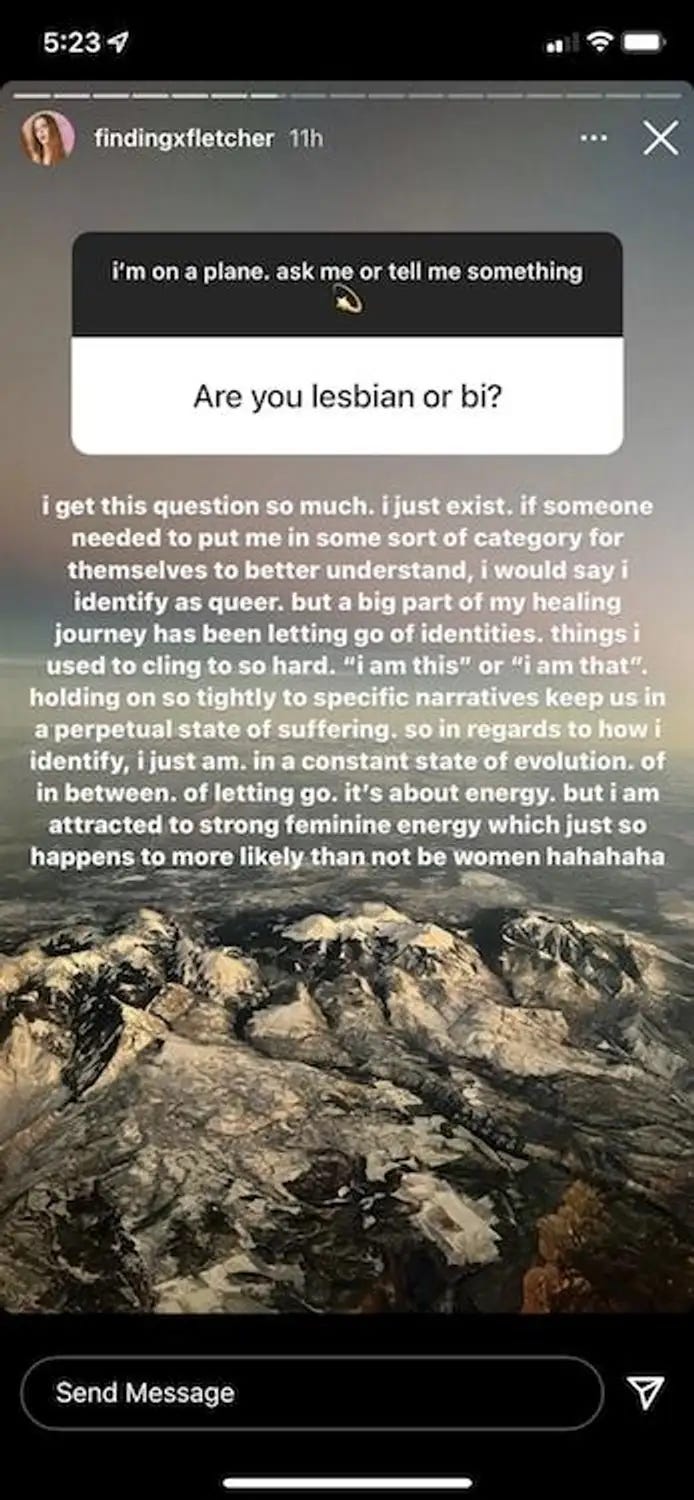
Two truths: neither Billie Eilish nor Fletcher claimed to be lesbian.
One lie.
JoJo Siwa, the ex-lesbian
The case of JoJo Siwa is different. Very, very different. And it will serve as an excellent case study in pop culture’s relation to lesbianism. Siwa came out as identifying somewhere within the LGBTQ initialism in 2021, at which time she was dating another young woman.
But like, I don’t know, bisexual, pansexual, queer, lesbian, gay, straight. I always just say gay because it just kind of covers it or queer because I think the keyword is cool… I like queer. Technically I would say that I am pansexual because that’s how I have always been my whole life is just like, my human is my human.
It’s interesting to note how Siwa takes for granted that “gay” can mean anything within the queer umbrella. Many people use “gay” that way. Many don’t, and would still rather it refer to gay male sexuality. However, I only highlight the wording because it can serve as an ideological, perhaps generational tell. Siwa has always been immersed in new ways of using LGBT terminology and new ways of conceptualising sexuality, with the various categories in the initialism sort of bleeding into one another.
“Lesbian,” in particular, has had a tendency to grow vaguer and vaguer in recent ways of divvying up sexual orientations or identities. In a 2023 conflagration in the gender wars, Johns Hopkins’s Office of Diversity and Inclusion updated their online LGBTQ Glossary with a definition of “lesbian” as a “non-man attracted to non-men.” This version still nevertheless defined “gay man” as a “man who is emotionally, romantically, sexually, affectionately, or relationally attracted to other men, or who identifies as a member of the gay community.” Men, not non-women. Also in 2023, Kathleen Stock noticed that new social science research often disaggregated sexual orientations in various unhelpful ways, sometimes lumping lesbians and bisexual women together, “including bisexual women in exclusive relationships with men.” Stock’s thoughts on gender are controversial—I’m not going down that rabbit hole here1—but it is telling for the Siwa saga that even academia has become wobbly on defining lesbianism.
In a notorious 2022 interview, Siwa stated that although she’s lesbian, she dislikes the term. “I don’t like the word itself, it’s just like, lesbian, it’s just like a lot. But I mean, at the end of the day, that’s what I am… It’s like the word moist.” Later, taking to TikTok, Siwa tried to cool off the resultant backlash, elaborating on her awkward statement about the word “lesbian”:
It is not a bad word, it is not a slur, and it is especially not a word that I am ashamed of saying or ashamed of identifying as, by any means. I don’t hate the word lesbian, I just — whenever somebody talks to me about my sexuality, I just say that I’m gay. It’s not the word that flows off the tongue for me, if that makes sense.
From what I recall, Siwa’s fame began to grow at this point among older drama-observers — not as a lesbian icon but as an annoyance.
In 2024, Siwa infamously put her foot in her mouth in another interview by claiming that she wanted to “start a new genre of music… called gay pop.” After receiving massive backlash, Siwa clarified to TMZ: “I definitely am not the inventor of gay pop, for sure not. But I do want to be a piece in making it bigger than it already is. I want to bring more attention to it.” She also admitted, per TMZ, that “she underestimated the public’s familiarity with queer icons.” Then she made things so, so much worse.
“Fuck the L, I’m going to the Q! That’s what I love about sexuality.” Thus spake Siwa as she re-identified away from lesbianism earlier this year, in a diplomatic way that was sure not to offend lesbians. Siwa then began dating a man, not long after her literal fuck-you to lesbianism.
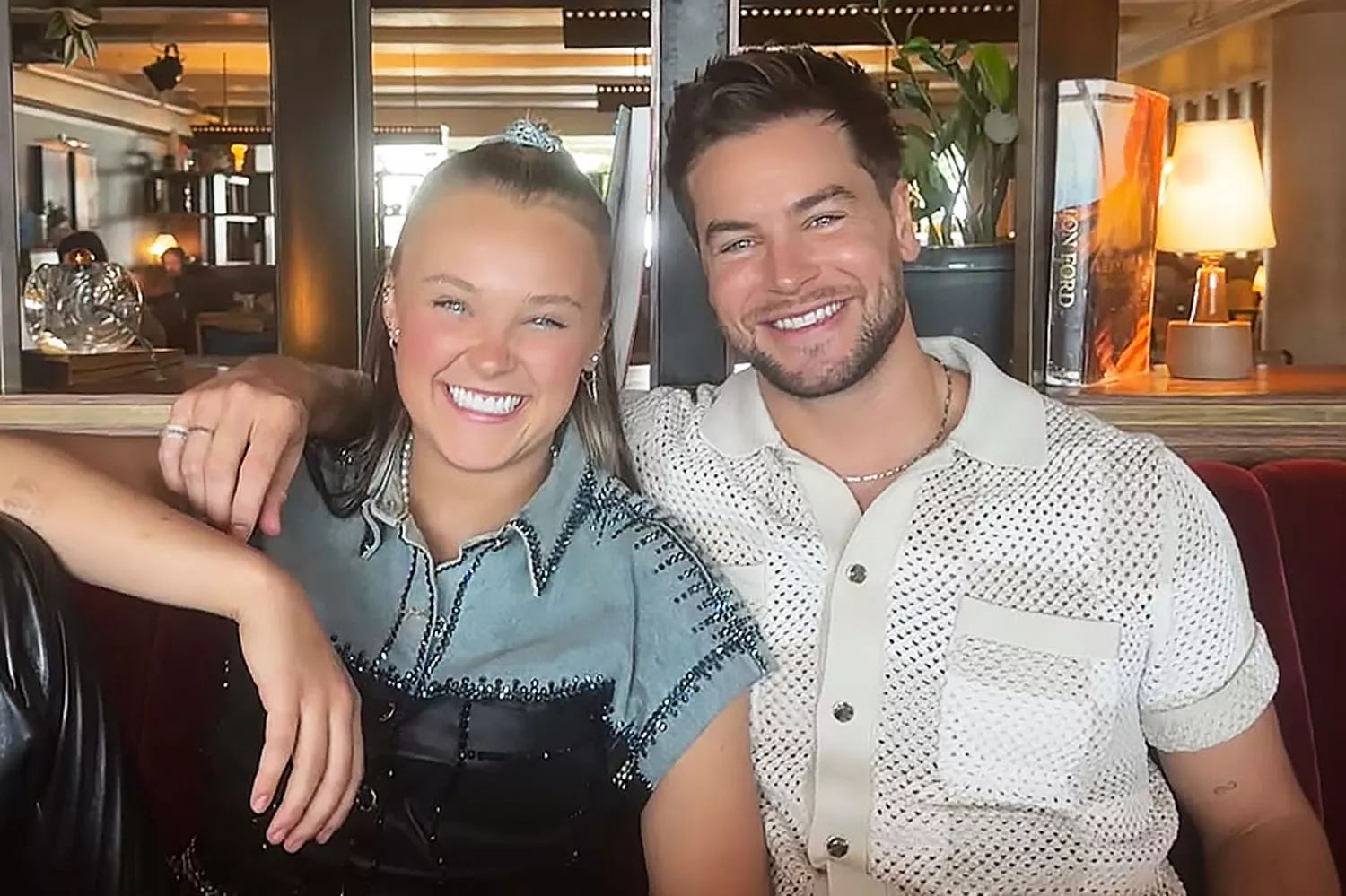
Siwa has alleged that she was lesbian but that her sexuality has changed. “Sexuality is fluid, gender identity is fluid,” she explained in an interview. She’s also claimed that she had felt “pressure” to identify as unchangingly lesbian.
When I came out at 17, I said, ‘I’m pansexual, because I don’t care [about gender].’ But then I kind of boxed myself in and I said, ‘I’m a lesbian.’ And I think I did that because of the pressure… In a weird way, I think [the pressure] came a little bit from inside the [LGBTQ] community at times. From people I know, from partners I’ve had. You just get put in this world where you feel like, because you now have said, ‘Oh, I’m a lesbian,’ you have to be a lesbian. And the truth is, sexuality is fluid.
fallout
Siwa came out as not-lesbian in April this year. Early this June, Billie Eilish’s relationship with Nat Wolff (who is a man!) was publicly confirmed. A few days earlier, Fletcher had released a single, “Boy,” that guiltily reflected on her own new relationship with a man, and worried about how the public would react. In an essay on her Substack newsletter, Trish Bendix expressed what seemed like a common sentiment among fans:
Fletcher’s ode to her boyfriend, though, felt particularly egregious considering that, unlike Jojo, fans took her seriously and, unlike Billie, Fletcher was more directly involved with and invested in her Sapphic fandom.
Again, nobody seemed to like Siwa or care for her as a lesbian icon. She’s mostly famous in my circles and online for being widely perceived as annoying. Eilish had come out as not-straight long after reaching massive mainstream popularity. Fletcher’s fanbase, however, was primarily invested in her as a sapphic icon, which meant that her ending up with a lad hit hardest of the three by far. Again, though, she had never claimed to be lesbian. It was messy PR; it was not a lie.
Yet, of course, three women singers who were known as being attracted to women all finding male beaux at roughly the same time was bait for the “vibe shift” genre of discourse. For Metro, Brooke Ivey Johnson wrote of this constellation of women who were attracted to men dating men:
Now, as summer 2025 looms, barely 10% into Donald Trump’s second presidency and amid a global surge in far-right ideology, the queer pop girlies seem to be suddenly dating men, with JoJo Siwa and Billie Eilish as two much-talked-about examples.
Johnson’s way of implicitly-to-explicitly connecting the global rightward political shift to bi women dating men was all too common last summer, and frankly irritating. The whole affair was messy, sure, but I don’t think many women became more drawn to men because of President Trump.
In worse write-ups and social media posts, however, people seemed under the impression that Eilish, Fletcher, and Siwa were all ostensibly lesbian until that moment, which is simply not the case. But it was, just like the vibe shift angle, an implicit element of this summer’s discourse. Sexuality had been troubled, in the minds of readers and listeners who were not quite clued in. I agree with Fleurine Tideman’s assessment of the fallout in a piece for Glamour: “society still struggles to grasp that bisexuality exists.” Onlookers seemed to wish that Fletcher and Billie Eilish were lesbian and JoJo Siwa were straight.
wherefore
Why did I go down this garden-path wormhole of women who were attracted to men suddenly dating men? It’s messy, as I said, and that’s the point: lesbian-associated, sapphic pop music was publicly messy and came under scrutiny from so many angles, through many cracked or smudged lenses. A certain domain of sapphic pop, wlw pop, whatever, was shown to be untethered from any stable sexual identity. It was not basic, for better or worse.
Outliers such as Chappell Roan and Chrissy Chlapecka (on the latter of whom see Part 3 of this series) are certainly lesbian (duh), but also flamboyant: they seek aesthetically to queer things up, often drawing influence from bimbo stereotypes and drag queens. They toy with gender.
Lesbianism’s image as a messy, gender-troubled or -troubling category manifested in the realm of wlw pop. One bubble popped quite visibly a few months ago, highlighting several key battlegrounds in our cultural gender wars. If it’s not a mild vibe shift, it’s at least the end of a brief era I vaguely think of as falling between the reign of Hayley Kiyoko, the so-called “Lesbian Jesus,” and wherever we are now, with parallel paths of basic and camp.
Now, for a few disclaimers, to be abundantly clear of my goals here. I’m only talking about pop: not folk, not rock, not country. Hence Hayley Kiyoko coming to mind, foremost. It’s by chance that I’m exclusively discussing femme artists. They’re just the artists I’ve encountered as a constant pop listener. I’m not excluding butch lesbians intentionally, and I am not digging through lists of lesbian artists; felicity is my guide, which is fine by me, since I’m sketching broad analyses, not amassing quantitative data. However, since I’m not omniscient, I’m sure that I’m not bringing up some relevant artists, so, leave a comment if you have useful additional points, as always. Now, back to the show. Basic lesbian pop.
back to basics
To restate my stance on being basic: I love basicness. I view being basic as a willingness to go with the flow of society, coupled with the will to find community and enjoyment in what seem like mere frivolities. Not many lifestyles are more prosocial than being healthily basic. Katherine Dee has argued that our “shared language of trends creates cultural coherence,” even much-mocked trends such as Labubus. I will likely write another screed someday in defence of being basic, but for now, I just want to emphasise that when I refer to the following artists as basic, I mean the term either neutrally or positively.
Jessie Paege
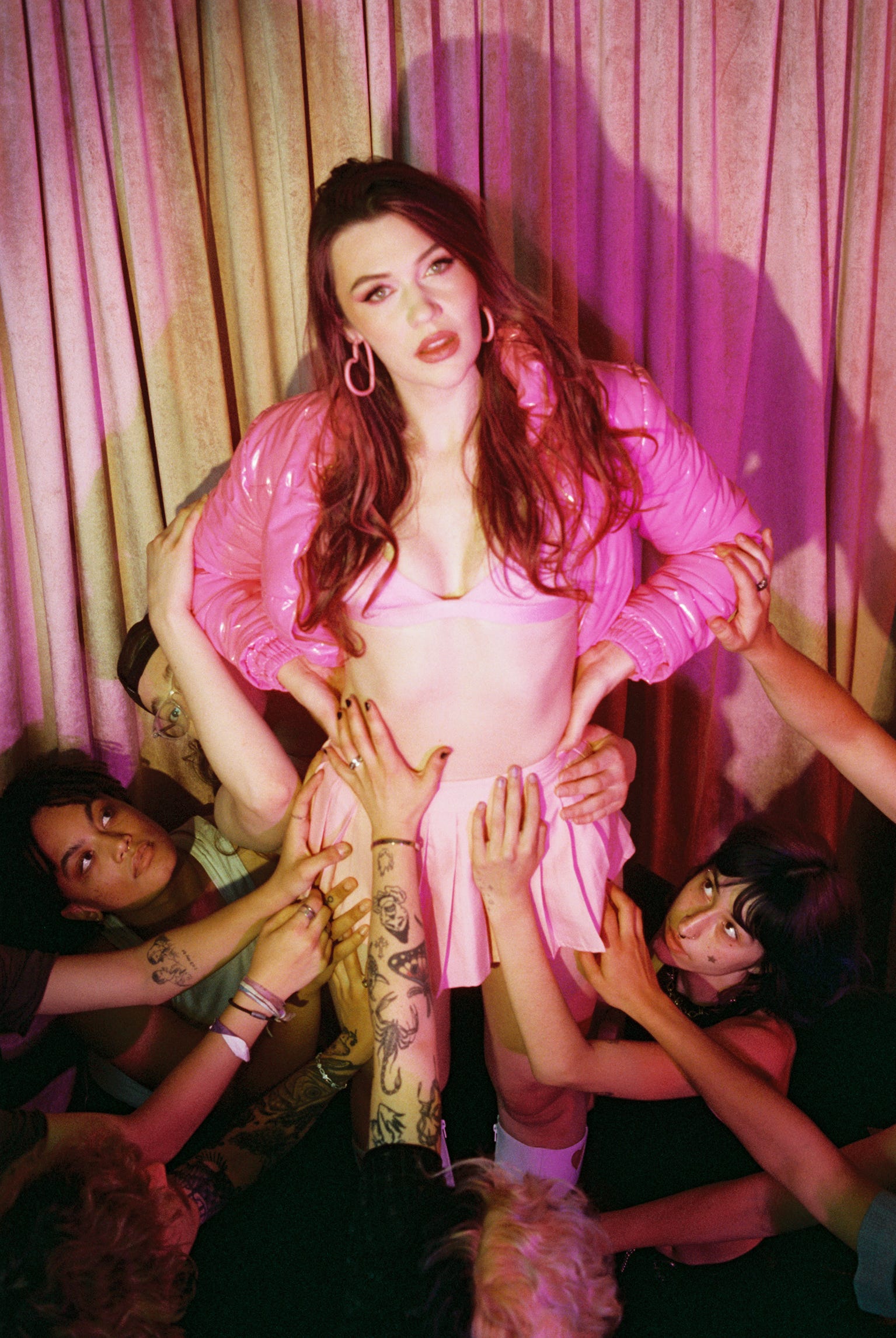
I could go into the careers of a number of up-and-coming lesbian pop singers, and it might annoy some hypothetical readers that I’m not diving into the complexities of, I don’t know, Zolita or Reneé Rapp. I want to focus briefly on Jessie Paege before moving on to the grand finale: Paige Galdieri.
Jessie Paege is lesbian, as she discusses at length in her aptly titled 2024 video, “I’m a Lesbian.”
A few things are worth noting about Paege in the context of the discourse at hand.2 She came out as bisexual in 2018 and realised gradually that she was lesbian through bad experiences dating men. The idea that she was pressured to be lesbian seems unlikely, from her own account. Now, she can state firmly, as she does in a 2024 interview: “I am a proud lesbian woman.” So there’s a change of pace from the above trio, our two truthers (?) and a liar.
More significant to me is Paege’s self-presentation. She isn’t embracing a total “bimbo” aesthetic like Chrissy Chlapecka (again, see Part 3). Rather, she’s just extremely high-femme. In the same interview, upon being asked what she does “to feel sexy,” Paege remarks: “As you can probably tell from my online content, I love showing off my ass in bright mini dresses and tailored suits.” Bright dresses, suits: straddling a line, sartorially.
It’s interesting to me how stereotypically hetero-normal Paege’s notion of sexiness is. She doesn’t lean into most lesbian stereotypes, and doesn’t express any desire to ignore them. She seems content to be the highest femme lesbian in the room. Her aesthetic per se isn’t “basic,” but she’s nearly at the farthest basic end of the “JoJo Siwa — Chappell Roan — Paige Galdieri” spectrum of lesbian pop basicness. Page is not wobbling through destabilised LGBT terminology (Siwa), she’s not doing deconstructive gay male or bimbocore camp (Roan/Chlapecka), she’s just a woman who is attracted to women, with a sort of campily yet normatively high femme aesthetic.
Paige Galdieri
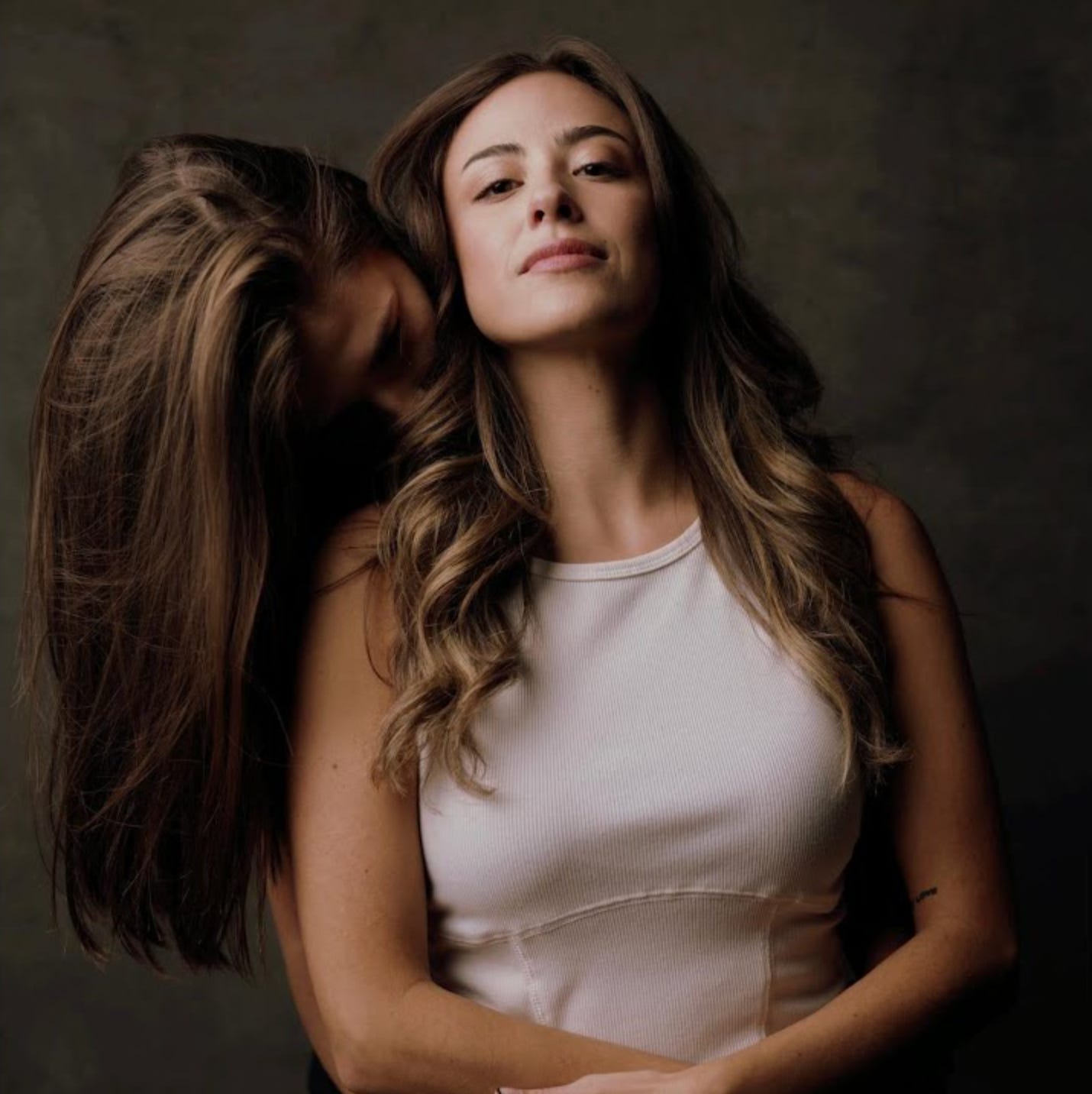
Most of my friends (yes, I have friends [yes, more than one {yes, I’m humblebragging}]) are well aware of Paige Galdieri, at this point, probably more aware than they want to be. But it seems most people are not. For that reason—because she’s not yet megafamous—it might seem odd for me to uphold Galdieri as so significant for my analysis, but she stands firmly as representative of the other end of the rainbow from Siwa et al., making her either unique or at least handy as an example.
In a podcast interview from this August, Galdieri gives a little bit of backstory as to why she decided to start releasing music.
I was at a Fletcher concert and I hadn’t been to a concert in a long time and I was like, I just I need to do this, and there’s no reason why I can’t try. I mean, all of my idols, you know, they had to start somewhere. And it was kind of a pinch me moment of like, okay, if she can do it, why can’t you just give it a try? The worst that happens is you put out a couple songs and you leave your footprint and that’s the worst that happens.
That crossover of Fletcher and Galdieri: as clear a symbolic passing of the torch as one might find in a biopic of an ancient empress — chef’s kiss. As Galdieri recounts in the interview, her most popular single, “She,” was the first song she released after coming out as lesbian. It dropped early in 2024. There is—and this needs further research—a tradition of lesbian songs called “She,” most famously by Jen Foster, but also Hayley Kiyoko. There does not seem to be a hetero tradition of songs titled “He,” though I’m sure some are out there.
In the same interview, Galdieri narrates her coming out story:
Mine wasn’t crazy. I am very lucky to have supportive parents. I literally— it’s so dumb. I’m really bad at like in-person confrontation. So, the way that I came out to my sister and my mom was the Spongebob “I’m gay” rainbow gif. And that was it. My mom was like, “Are… for real?” I’m like, “Yeah.” She’s like, “Okay.” Like, that was it. And my sister and my brother were like, “I mean, we knew that.” So, they clearly knew. And yeah, my dad, I just told him in the car. He picked me up from the airport and I told him and it was all fine. And so it wasn’t crazy. It was more just like ridiculous how I sent a Spongebob picture to tell my family. And then I had them tell everyone else cuz I wasn’t about to call up like my grandma and do that.

Admittedly I’m a bad Spongebob scholar but I assume she’s referring to some variant of the above classic gif. Galdieri acknowledges her luck at having such an easy experience leaving the closet. Compared to many other artists’ coming out stories, hers is notable for being so lowkey. It’s funny, it’s sweet, it’s the picture of normalisation.
Turning back to “She,” one line always stands out in my memory (well, I know all the lyrics, this one just stands out most): “Your arms like an autumn breeze.” An autumn fan. Further: an autumn fan who likes pumpkin spice candles.
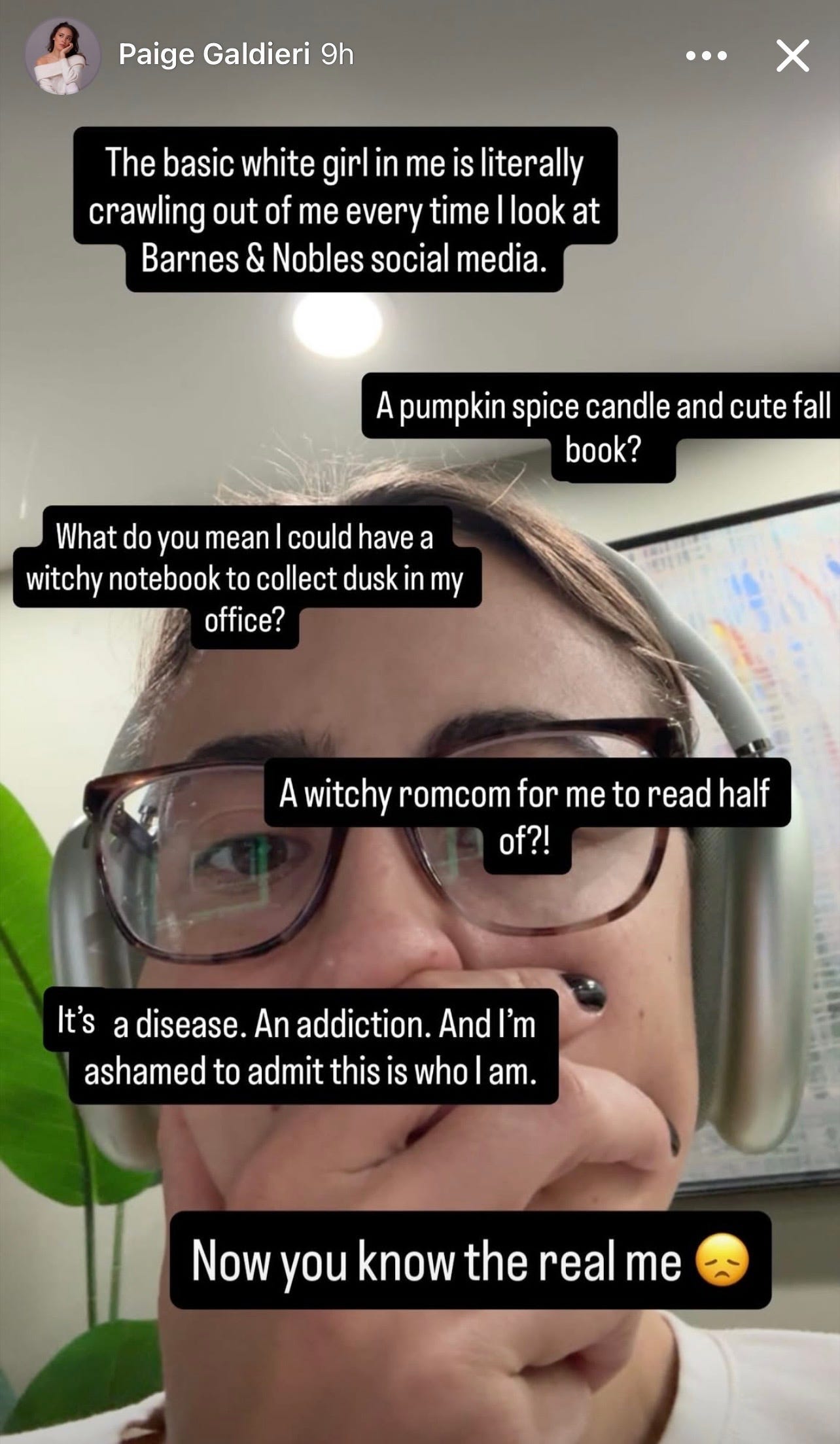
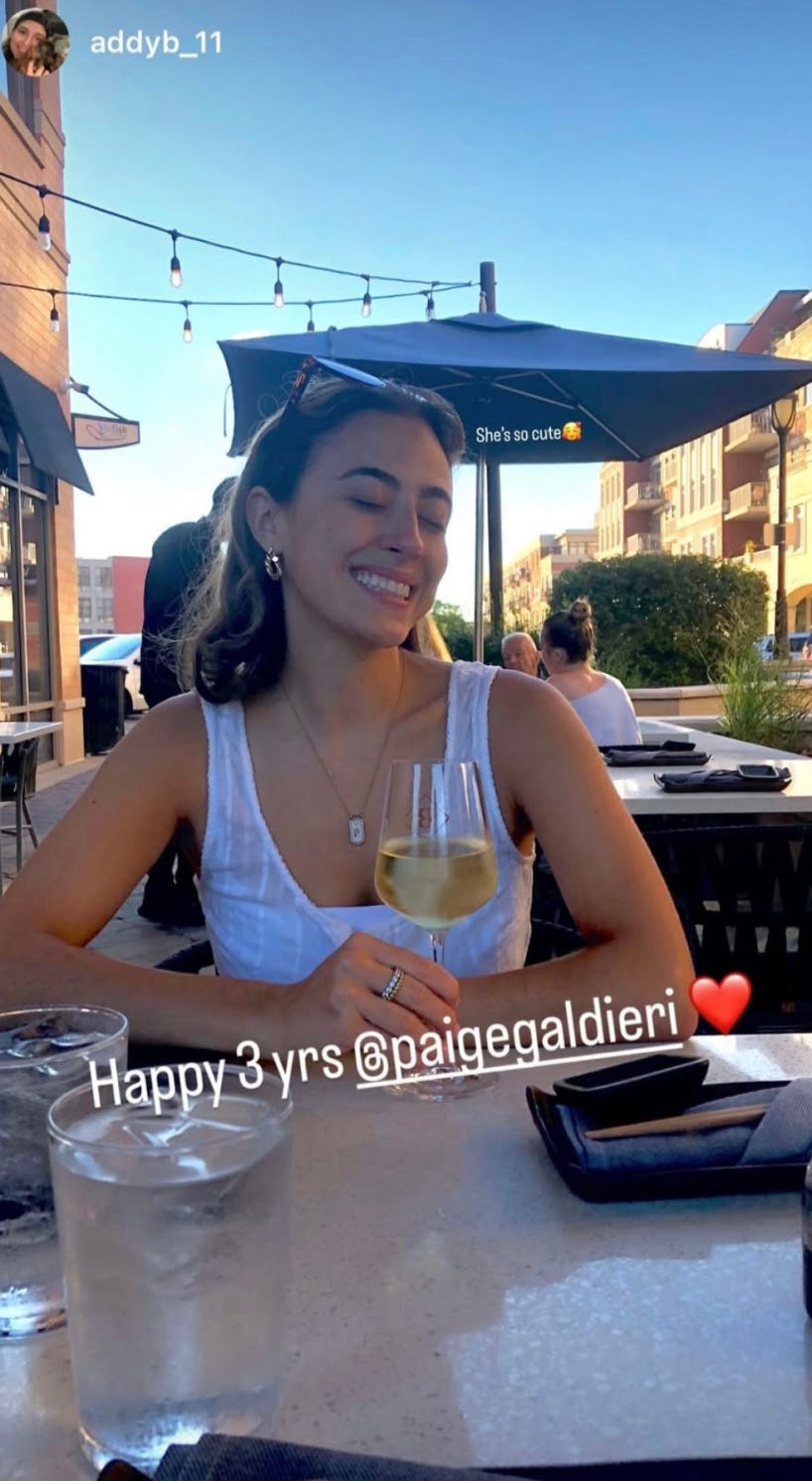
Galdieri’s Instagram (yes, I screenshotted this on Facebook, don’t murder me) is full of cutesy, basic content. Far from avoiding the appellation of “basic,” Galdieri leans into it, with mock embarrassment. She posts ordinary, lovey content about (or from) her longterm girlfriend, whom she met on a dating app.
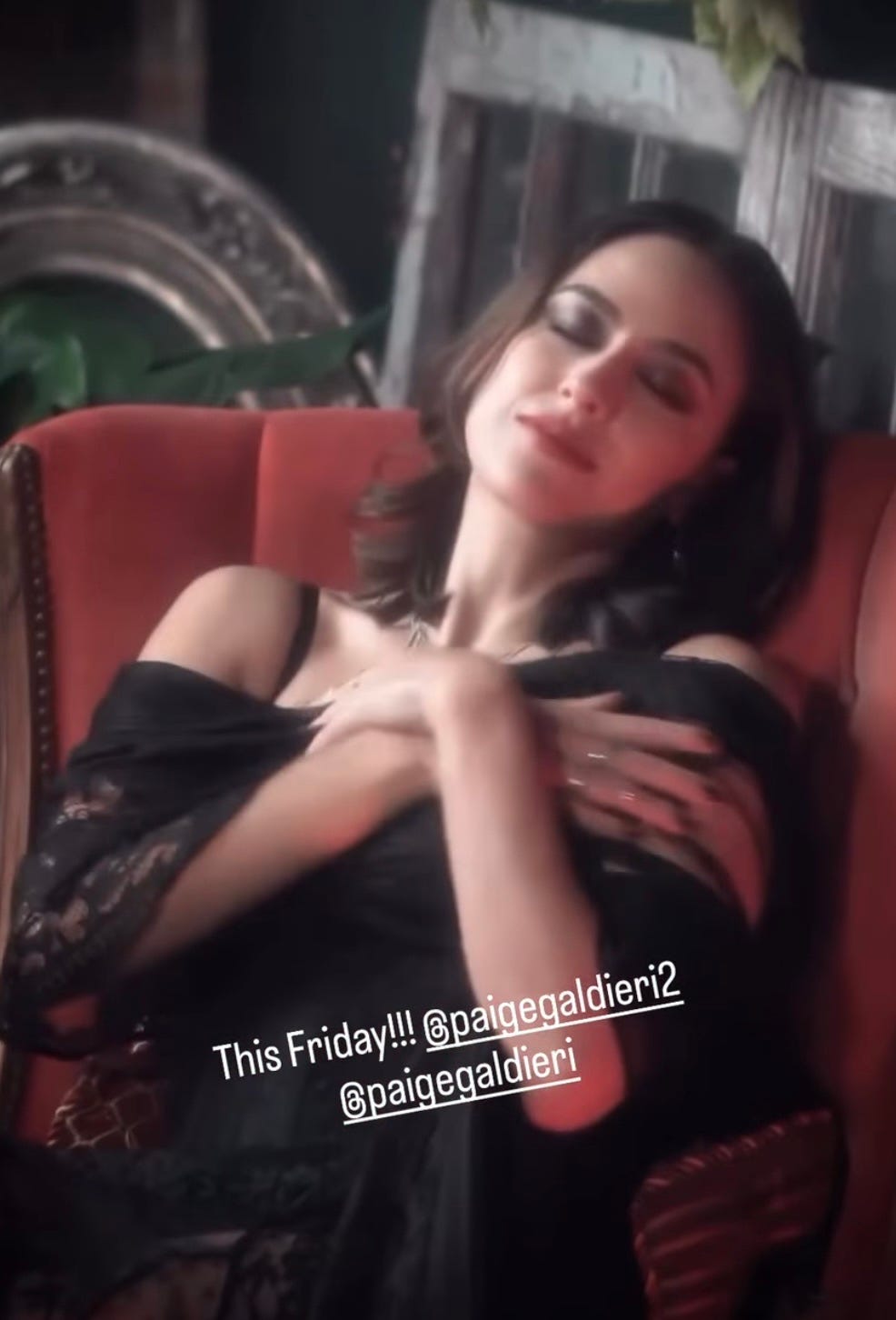
Galdieri is undoubtedly femme, and has recently even femme-fataled it up for a new single, “Hold Me Right.” In general, though, she adopts a non-campy, everyday degree of femme presentation.
Galdieri’s public image is basic. Her aesthetic is, most of the time, heavy on coziness. She’s not playing respectability politics because she isn’t playing politics, just guitar. She writes cute love songs and sings them well, and lives out what seems like a wholesome relationship with her partner. She’s serving satisfied normalcy. Paige Galdieri presents a conundrum: there’s hardly any language with which to analyse the work of a lesbian artist who is content with being basic. Scholars’ critical antennae are fine-tuned to the frequencies of isolation and pain, not pumpkin spice and anniversary photos on Instagram.
There are, undoubtedly, various ways to analyse the JoJo Siwa—Chappell Roan—Paige Galdieri spectrum. Some might argue that one end or another is politically best; some might argue that a butch version of the spectrum would be needed to engage in a fuller lesbian feminist analysis. Maybe someone more up on lesbian celebrities than I am will find the time to concoct such a spectrum.
I can imagine that some critics will view the basic end of the spectrum as naive, as quietist, as problematically apolitical. That is not my stance. I view sexual orientation as a fact of life, not as a statement in need of debate in the political arena. I find it comforting to see fellow LGBT people live how they want, especially when they seem like they’re having a good time of it. What else was the point?
Having weighed the political stakes and listened to basic lesbian pop all night, I’m going to get an iced pumpkin cream chai latte in the morning.
Previously, on post-femcel femininity…
Part 1
no caps feminine vs. ALL CAPS FEMININE: will you be an adult girl or will you KILL YOUR MASTERS?

A few years ago, I saw someone on Discord say that if his posts have any capitalisation, you know he’s posting from the toilet. Simply: his phone auto-capitalises and his laptop does not. In other cases, though, there’s something more to capitalisation than autocorrect being on or off. Capitalisation can have meaning.
Part 2
what it means to be "just a girl" in a post-maiden world

I’ve been behind on my writing schedule, but after all, I’m just a girl!
Part 3
![BIMBOCORE vs [B]IG [D]UMB [S]TUPID [M]EN: spectacular femininity or DOMINATRIX FEMINISM?](https://substackcdn.com/image/fetch/$s_!KxZx!,w_1300,h_650,c_fill,f_webp,q_auto:good,fl_progressive:steep,g_auto/https%3A%2F%2Fsubstack-post-media.s3.amazonaws.com%2Fpublic%2Fimages%2F435fdcee-5324-4bd7-be35-72a8df653429_640x640.jpeg)

Part 4
pick me (a history)

A note to hypothetical new readers: although post-femcel femininity is a series, each post in the series can stand alone. I’ll refer back to parts 1-3, but it’s not necessary to read them to comprehend this post. However, I’d of course encourage you to check out parts 1-3 and the accompanying miniseries of outtakes afterward! (Links at the end.)
Outtake 1
against representation, revenge, and the lonely man's love: Emilie Autumn's radical feminist parables

Post-femcel femininity is a series of posts that I’ve been writing for a little while, and although those posts are long and labour-intensive, I’ve had to trim some parts that I found interesting. Additionally, some ideas for posts in the series did not spur enough material to merit a full post, but still seemed worth writing up. I’m taking these delete…
Outtake 2
girlrot grammar

Post-femcel femininity is a series of posts that I’ve been writing for a little while, and although those posts are long and labour-intensive, I’ve had to trim some parts that I found interesting. Additionally, some ideas for posts in the series did not spur enough material to merit a full post, but still seemed worth writing up. I’m taking these delete…
Since I’m me, and it’s a personal pet topic, I find it worth adding in a footnote that Paege has spoken openly about her struggles with disordered eating, even releasing a song about it.
Admittedly, lesbian pop has not been on my roster, so the entirety of the content of this essay was new to me and I enjoyed it so much! The consideration of Paige Galdieri brought to mind Stephen Bradford Long’s comments queer identity and the nature of equality, and his desire to be free to explore his humanity and his individuality beyond the label of “gay”. I’m not queer, so perhaps this is an ignorant statement, but it seems to me to be a really, really good thing for LGBTQ individuals to both experience and reference life from this basic framework you mentioned. It’s simply lived experience with reduced emphasis on those things that set a person apart. In my own experience, the more you can reduce the emphasis on the distinctiveness the more you can find commonality, the more you build on commonality - without pretending your own distinctive experiences you do not exist, simply changing emphasis - the more you can build a sense of normalcy for yourself, which helps protect against feelings of isolation by building diverse community. Anyways, long ramblings, but I really enjoyed the post - as always!
i know this is a substack that's a month old, but my (unsolicited) advice in all this would be to not form parasocial relasionships with celebrities. stuff like this always reminds me of my favorite scene from A Bronx Tale: "Mickey Mantle don't care about you, so why do you care about him?"
https://www.youtube.com/watch?v=2WkP_S5gmmg