

Things Christians get wrong about Judaism
Talmud, "Reformed" Judaism, and more!

I can get annoyed in conversations with Christians about Jewish topics sometimes, and that’s mostly my emotional problem, but also, I realised it might be useful to the -6 Christians who read this blog if I were to write a quick guide to see if I can root out some common Christian errors I come across. I’ll only hit a couple of these kinds of error and might follow up with another post in a similar vein if anyone finds this useful.
I might sound snarky at times below, but I don’t have any ill intent. It’s just that some of what I’m about to say seems like common sense, but apparently isn’t, but it can be hard to explain what seems like common sense without sounding like a dick. Apologies in advance if it sounds like I’m trying to be insulting.
There is no such thing as “Reformed” Judaism
This is a quickie. Oftentimes, people accidentally think Reform Judaism is called “Reformed” Judaism. This is probably because of Reformed Christianity. But nope. Reform is just Reform.
Judaism is not (necessarily) derived from the “Old Testament”
Although the Torah and other two parts of the Hebrew Bible (more on them later) are of paramount importance in Judaism, they have not been the central pillars that define Judaism since Rabbinic Judaism rose to dominance, beginning in Late Antiquity. (Note that early Rabbanites were in part the successors of the Pharisees. Please stop insulting Pharisaic Judaism just because of New Testament polemics against Pharisees!!!)
Rather, Rabbinic Judaism is defined by having the “Oral Law,” or what became the Talmud. This has led to splits with a few groups of Jews over the centuries, most notably the Karaites, of whom there are still a few. Non-rabbinic Judaism is a massive outlier and has been for many many centuries. What we refer to as “Judaism” today is Rabbinic Judaism. Thus, Jews sometimes dedicate more time to learning Talmud rather than the Torah straight-up, let alone the Prophets or Writings that make up the rest of the Hebrew Bible.
This is why it can bother some of us when people ask questions like, “How did this idea get derived from the ‘Old Testament’???” It probably was derived from the Hebrew Bible at some point, Talmudic logic is complex and nuanced, and midrashim (rabbinic interpretations, expansions on stories, etc.) are almost always loosely based on what’s in the Hebrew Bible, but Judaism as it has existed for the last 1,700 years or so has not been defined by the Hebrew Bible alone or primarily. What one might call “Jewish scripture,” what we treat as scripture, is vastly bigger than just the Hebrew Bible.
We aren’t Christians-minus-New Testament. We have our own liturgical traditions that influence our teachings, we have much later sources of authority than just the Hebrew Bible, and so on. We are a radically different religion from Christianity.
The Talmud is not a code of law or a commentary on the Torah
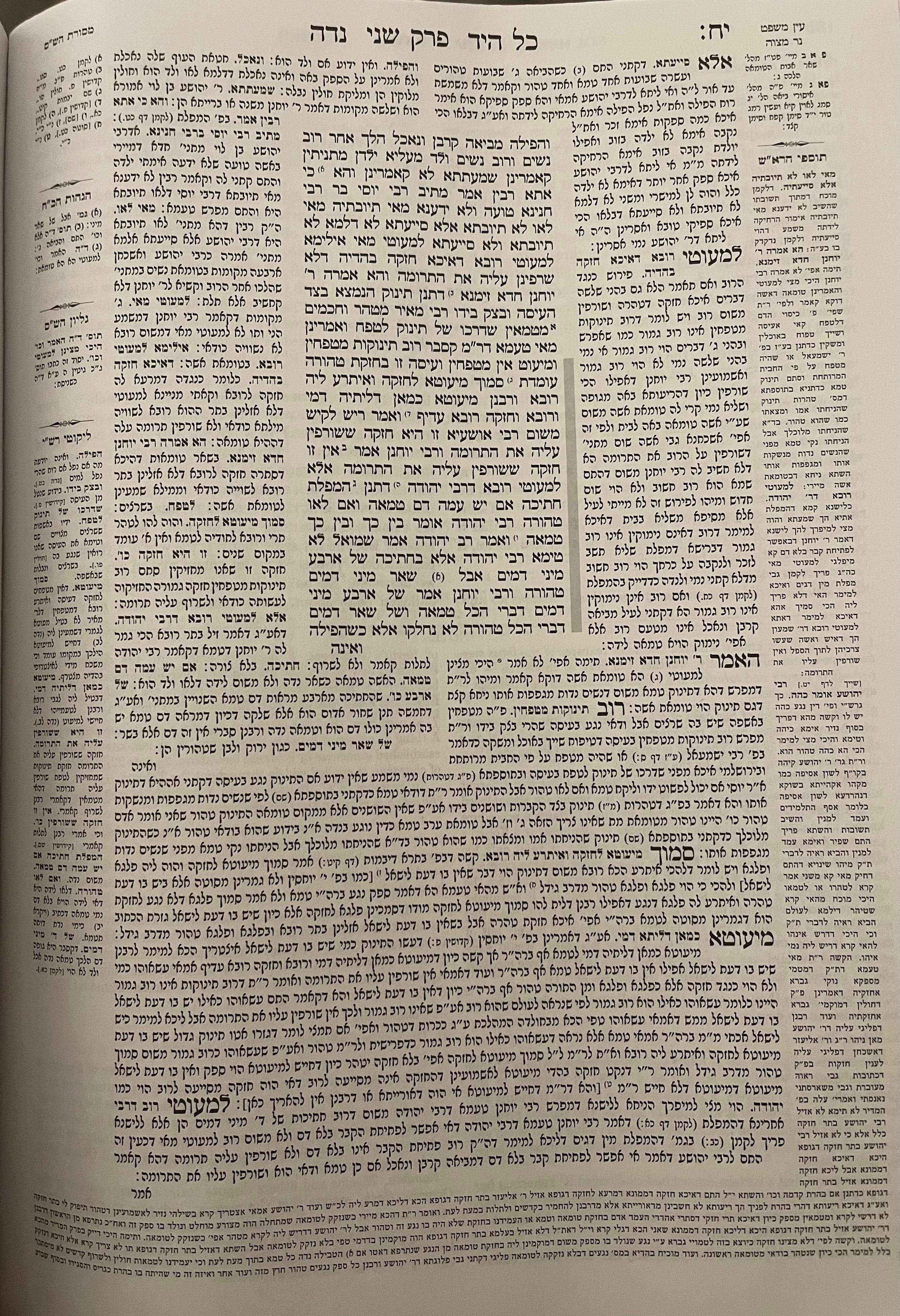
The Talmud is a lot of things, but I often see it mistaken for either a code of law along the lines of, like, most of Leviticus, or a commentary on the Torah. The former error leads people to think that any opinion expressed in the Talmud is Jewish law. Such is not the case — to see what actually made it into Jewish law, see the Shulchan Aruch and various more localised treatises, not the ancient document that is the Talmud. The latter error leads to oversimplifications.
The Talmud primarily consists of two components: the Mishnah, which records early rabbinic legal debates, and the Gemara, in which slightly later rabbis argue about the Mishnah and the Hebrew Bible (Tanakh) and tell stories and all manner of things. It’s not a commentary on the Torah, it’s not a code of law, it’s sui generis. It’s weirder than whatever you think it is, in a good way. And of course when studying Talmud there are a billion-trillion later commentaries to study with it.
Studying Talmud is a lifelong endeavour. If you ever hear someone say offhand that they “read the Talmud,” they are probably either lying or direly mistaken. You can see how huge it is here, and with that much difficult text on every page, you slowly study Talmud, you don’t read it like pop nonfiction. Many people participate in the Daf Yomi cycle, in which you read one page of Talmud a day for seven years to get through the whole thing. Even that can seem relatively fast to me.
The fact that the Talmud is not a code of Jewish law serves to debunk a lot of antisemitism that swirls around rumours of what it contains. Certain rabbis in the Talmud do pose wild interpretations of certain laws — these did not make it into Jewish law. That’s kinda the methodological point of Talmud: go where the conversation leads. And sometimes it leads into, and out of, murky waters. This is also why there is no distinction between “highbrow” and “lowbrow” antisemitism. Antisemitism is based on blatant disinformation from ancient and mediaeval times all the way down. Having a lick of sense about Talmud will serve to dispel rumours. Clearly, antisemites don’t have that lick of sense. They’re idiots.
The Hebrew Bible is not the same as the “Old Testament”
This is a slightly more nitpicky point, but I often see Christians refer to the Hebrew Bible as the “Old Testament” when trying to discuss it outside their own framework. In their Bibles, it is the Old Testament; as it exists outside Christianity, it’s different.
Firstly, the Christian sense of the Hebrew Bible is usually very filtered through the Septuagint, which is not the Hebrew Bible. It’s a Greek translation that many Jews of the New Testament era had to rely on. Worse, the Septuagint is in fact based on a different textual tradition of what the Hebrew Bible contains from what Jews actually rely on today, which is the Masoretic text. The Masoretic text was not settled until the Middle Ages, the Septuagint is a translation from the final few centuries BCE.
Secondly, the Tanakh is not in the same order as the Christian Old Testament. It’s divided into three parts: Torah, Neviim (Prophets), Ketuvim (Writings), abbreviated as Tanakh. Accordingly the books of the Tanakh are ordered differently from the Christian Old Testament.
I’d rather Christians refer to the Tanakh as the Hebrew Bible when referring to the “Old Testament” as it exists outside their tradition, because they aren’t the same thing. Even small differences make a big difference.
Plus, calling it the “Old Testament” is a doctrinal statement. This is why especially non-Christians should be careful of the term: they surely don’t want to make a claim about how Christianity superseded Judaism, right?
Conclusion
I think a brief point I broached above is the source of a lot of Christian confusion about Judaism. Christians often hold the vague idea that Jews are, or should be, something like “Old Testament”-only Christians. If something doesn’t immediately make sense based on Christians’ personal understanding of the “Old Testament,” they get confused. That is almost always because our tradition is centrally based on later sources — or because Christians have a harder time studying the Hebrew Bible, given they more rarely understand Hebrew, but that’s a whole other can o’ worms and not worth getting into here. It’s less of a fundamental issue than the basic factual error of thinking that contemporary Judaism is supposed to be solely based on the Tanakh as its sole authority.
That’s all for today!
For more introductory content on Judaism…
A brief tour of Jewish theories of the Messiah

The Messiah (more properly, Mashiach) is one of the most famous elements of Judaism, although it’s an element that doesn’t always matter to Jews. Because a Jewish messianist movement went on to become the biggest religion in history, people have a lot of interest in, and misunderstandings about, Jewish messianic beliefs, which differ drastically from wh…
A brief tour of Jewish theories of evil, from the Hebrew Bible to the kabbalah

This blog is part gender, part religion. I’m aware that this combo loses me subscribers. If you like to hate-read the gender stuff, stick around, it’ll return shortly. If you like to hate-read the religious stuff, stick around, the next gender post isn’t the end of my religious posting.
how not to study kabbalah

A lot of people go in weird directions while studying kabbalah, the generic term for Jewish mystical thought since the middle ages. They either waste their time or arrive at strange, often oversimplified misunderstandings. Most often they do both. This is because kabbalah seems broadly appealing but is extremely difficult to learn. Complicating matters,…
ways to engage in Jewish learning without getting out of bed

Here are two things that are true about me: I worry that the Jewish world is in a crisis of learning and I like to laze around in bed. Thus I wanted to give some tips on how to hone your Jewish education without leaving bed, because I could use the same kind of advice sometimes.
One of the 6 Christians here! (I assume you mean “around 6 Christians” and not negative 6 Christians)
I appreciate your Substack a lot because I’ve had some interest in Judaism for a while and have poked around on Jewish subreddits, but I’ve been wary of engaging because they seem to view Christians as intrusive. So it’s awesome that you’re clearly so open to engaging with Christians!
Christians often take for granted how their own doctrines were elaborated on by various theologians over the millennia, so it makes sense that Judaism (and arguably all religions) continued to grapple with emerging problem sets and continuing the age-old debates.
I find there's a similar issue with Christians with paganism, in that they expect us to have a single book or text that has all of our beliefs coded within it, or that we believe our myths are both literal history or making definitive infallible statements about the Gods. In reality, pagan beliefs encompassed variations on mythologies, temple writings, philosophical works, and lists of aphorisms and proverbs. This desire for a one size fits all single document is largely a Protestant *sola scriptura* affectation, and I think that same assumption makes them think that the Talmud is just like a counter-New Testament.