

risks of touching grass: online life as exilic experience
notes on Ezra and Elektraspace

internet community as exilic experience
I’ve been enjoying thinking through Ana Levy-Lyon’s recent book, The Secret Despair of the Secular Left, and although I have disagreements with some aspects of it, I appreciate how many dense concerns it grapples with in approaching the woes of modernity. I’ll probably write more later on why I think “modernity” as a spiritual disaster is a religious cop-out in a lot of the ways it gets brought up, but in this case she’s mostly looking at the landscape of social and mental pains that have accompanied modernity, so I’ll let that adjacent error slide here.
One of the most compelling through-lines of the book concerns the replacement of real-world community with online pseudo-community. Levy-Lyons runs through some of the ways that online life has become appealing or necessary for us: FOMO from constant information, a detachment of community from place, the diminishment of what counts as “friendship,” and so on.
Ultimately, the virtual world distances us from ourselves as embodied. She points out that dematerialised online life, “where the important substance of a ‘person’ is expressed immaterially while the physical body is at best an adornment to the self and at worst an encumbrance” (48-49) is in a significant way the opposite of modernity’s older secular materialism.
With the body as not just irrelevant but an encumbrance, I can’t help but think of the risks of returning to fleshly community. Not just the risks of avoiding the news or X for a day, but the risk of returning to being flesh near other flesh. Who, in the fleshly way, would someone be, if they’re used to being an avatar, or even an anon?
Levy-Lyons implicitly frames online, dispersed social life as a kind of exile. In the experience of the social media addicts whose lives she discusses, leaving behind their phones is a kind of exile, as “[t]oday’s online communities function as our tribes” (65). However, having our tribes be far-flung in the physical world is a truer exile, even “an injury that affects the whole body” (68). And if we are to take the online world as pure spirit, just soul defleshed, the all-important dictum from the Words of the Lord applies: “in this world, everything that is of the spirit must be turned into flesh, just like our own” (§548).
risk of return: identity
People really underrate the books of Ezra and Nehemiah (which formerly tended to be one book, Ezra-Nehemiah) in thinking about the effects of societal fragmentation and alienation. As the Israelites return from exile with the permission of the Persian rulership, they have to sort themselves out. The adjustment is no longer to fragmentation, but to being together again. And that’s shockingly hard, at personal levels for those involved.
A heartbreaking but understated moment in Ezra always stands out to me. I’ll quote it.
Of the sons of the priests, the sons of Habaiah, the sons of Hakkoz, the sons of Barzillai who had married a daughter of Barzillai the Gileadite and had taken his name — these searched for their genaeological records, but they could not be found, so they were disqualified for the priesthood. The Tirshatha [an authority figure] ordered them not to eat of the most holy things until a priest with Urim and Tummim should appear.
—Ezra 2:61-63
A family who had apparently viewed themselves as of the priestly lineage find out that they can’t back up this claim, upon returning to a situation in which such status would be crucial in reestablishing Temple worship. The priesthood comes with extra responsibilities, and with food: the right to eat of the sacrifices (as delineated primarily in Leviticus). What a shock it must’ve been to find out that their family isn’t necessarily priestly! In exile, I assume they had functioned a certain way. Now their identity is shattered — and their perceived authority crushed. Which felt more like exile, in hindsight, I wonder: being priests in exile, or losing priesthood at home? Is the perceived self home, or is the land home?
The ruling that the family needs to wait until a priest comes with the traditional divination devices of the Israelites to sort out their situation is actually a searing finality. As Rashi clarifies:
[This is] like a person who says to his friend, “Until the Messiah comes, this matter will not come about.” I cannot interpret it to mean: until a priest arises for the Urim and Tummim in the Second Temple, because we find in Yoma (21b) that the Urim and Tummim were missing in the Second Temple.
So basically, the Urim and Tummim aren’t coming back anytime soon, and the ruling about the maybe-priestly family is like, “Wait until everything is fixed at the redemption of the world, when the Urim and Tummim might be back, then you’ll know.” When pigs fly. Or, uh, when pigs are kosher.
The family’s identity is already broken; now they know that the uncertainty that caused their shift in communal and self perception is here to stay. That’s a risk of returning from exile: maybe you aren’t who you thought you were. What you could be in exile was not what you can be upon return.
return ambivalence
Identity disjunction is a risk that all terminally online people face upon returning to earthly life and fleshly society, one that goes under-acknowledged outside very specific concerns, like seeing oneself in the mirror after becoming accustomed to Instagram filters (as Sofia Isella notes, “we look so much better when we’re in the phone…”). Yes, it’s difficult to let go of the dopamine machines in our pockets or purses. But it’s also difficult to accept that the identity we formed online, the person we curated for others and with which we came to identify, might be irreconcilable with who we are or can be offline.
Online, as many have written, we have more freedom to (pretend to) be anyone. “On the internet, nobody knows you’re a dog,” as the old meme went. The flesh is a limitation against which we often struggle, which we often have to struggle to love, and which limits the possibilities of our identities. Online, if we don’t love something about ourselves, we can just delete it, filter it, hide it. Sometimes we can highlight or make up things about ourselves for one space and not another.
Power plays a role here, too. In Elektraspace (Aristasian jargon for the online world), you might moderate a Discord server of 1,000 members with an iron fist. In earthly meatspace, you might flip burgers at a ghost kitchen. This is the risk of return from exile. It’s a mundane equivalent to that suddenly non-priestly family in the book of Ezra.
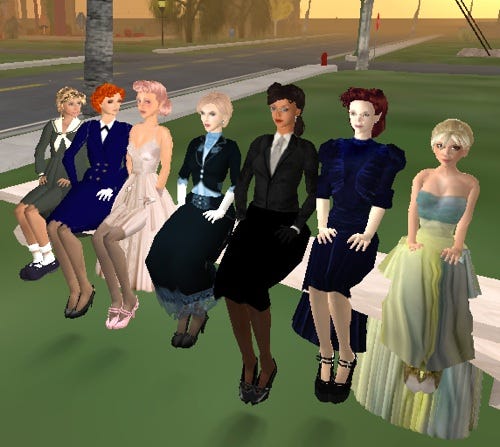
Yet the exilic experience of online life is always already limited by the body — and the opposite is not necessarily the case. I’ve heard stories of MMORPG battles that are in part decided because players in one time zone have to go to bed. The relation of afk meatspace to Elektraspace/Virtualia is thrown by an asymmetry that I think about often: on the one hand, if many types of disaster strike in the material world, the internet goes down. On the other hand, if the internet goes down globally, a lot of our world would fly into chaos, but the earth would continue to revolve. The stars would still shine as the pixels flicker out. There’s nowhere else to return than the dirt and the flesh. And that transition can break our hearts.
Now I need an essay exploring Aristasian subculture and why the online world is specifically referred to as the Elektraspace, because my curiosity is thoroughly peaked. I very much enjoyed this essay - I’ve got a standing appointment to play Minecraft with my boys, so I’ll have to come back to this later, but I did want to take a moment to comment and thank you for this piece!