

the internet's terrible grace
notes on esoteric Deeist geography

“The Internet has a geography; it is a place more than it is a communication tool. It has cities and towns and houses and rooms and rooms within rooms.”
—Katherine Dee writing on online communities
Lately, I’ve been thinking about Katherine Dee’s description of the Internet as having a geography, among other ideas that I’ll get to in future posts. For now, I want to penetrate the notion of online space in an esoteric, mystical, metaphorical way. The way that we experience the Internet is a lot different from how we talk about it. The metaphorical-esoteric approach can be useful for sorting through how the Internet exists as a phenomenon if not as a thing proper (Dee — “enchantment restores what habit has made invisible”). Dee’s geographical language for for the Internet is fascinating and useful.
I’ll be writing in little mini-essays or aphorisms here and in some future posts on esoteric ways of thinking about the Internet.
Yenne Velt
Dee argues at the NYT that the Internet is:
not a drug, nor a set of behaviors, but a place we travel to, with its own geography and customs. It’s not a physical place, but it’s no less real. Anyone who came of age online knows the feeling of crossing that threshold: When you log on, time runs differently, the body slips away…
Thus Dee compares the Internet to an Otherworld or Fairyland, a place with its own rules, a location that we fall into and bring things out of. I’m personally most familiar with Jewish folklore about the Yenne Velt, the Other World, known typically in Jewish theology as the Sitra Achra, the Other Side — or the Left-Hand Emanation. The Left-Hand Emanation is known as such because it (and thus evil) emanates leftward from God’s attribute of Harsh Justice, Din. The Yenne Velt is taken in folklore as a demonic mirror of our world, founded on its own inverted divine attributes and obeying its own evil principles under its rulers Lilith and Samael or Asmodeus.
The Internet does emanate from somewhere. Dee notes that “[o]ur earliest language about the internet seemed to understand its nature best,” particularly it seems with its notion of cyberspace. And I wonder if this is because earlier users were more connected to the materiality of it all. In her book Network Sovereignty: Building the Internet across Native Land, Marisa Elena Duarte reminds us that “[u]nderstanding the tangible material aspects of the Internet helps ground philosophical discussions about digital technology…” and that creating and keeping up the Internet requires “formidable labor.”
I recall too Eula Biss’s essay on the telephone pole, “Time and Distance Overcome,” which focusses on the difficulties faced by telephone companies in constructing poles, recalling that the prospect of constructing such infrastructure “seemed far more unlikely than the idea that the human voice could be transmitted through a wire.” Then Biss dives into the history of telephone poles’ usage in lynchings. Nevertheless, as she expresses in among the final sentences of her essay, “nothing, I would like to think, remains unrepentant.” An anthropomorphising of information’s materiality, even a spiritualising, that would imply here that even if the Internet is a left-hand emanation of the material world, it may yet be redeemed.
creation
Phenomenologically functioning as a geography, the digital Yenne Velt has a key difference from this world: it’s reliant upon its mirror. If the power goes down, the digital geography blinks. If the Internet goes down, our world flies into chaos, but our materiality predates and will postdate it. The same goes for the Yenne Velt — cut it off the Tree of Life, its emanatrix, and it is gone.
What this means is that the Yenne Velt is sustained eternally and perpetually through our Side’s force of creation. This is what is known in philosophy as occasionalism, reestablished in early modern times through what seems like the more radical wing of Cartesian thought. Occasionalism holds that God’s creative power holds us in existence at all times.
For it is clear, if one considers the nature of time, that the same power and action is required to conserve any thing, whatever it may be, in being during the individual moments in which it continues to exist, as would be needed to create the same thing from the start if it did not yet exist.
—Descartes, Meditations III
In other words, per Descartes, it would seem that God must be constantly creating us. It’s not as if God created us once and set us a-bein’ like a spinner drops a top. Rather, God keeps God’s fingers on the top’s stem and twirls it. That seems like how the Internet’s creation functions — occasionalistically. Except sometimes it is as if the harmony of the spheres through which God coördinates the dance of our online world grinds itself to a halt, reverses its course, demonises the orders of angels above it, and tasks them with killing God. The action goes both ways once set in motion; we gods of the Internet are influenced by our toys, perhaps with “influenced” taken in an energetic, astrological sense.
grace
One of early modernity’s chief occasionalist Cartesians was Nicholas Malebranche, who held that God acts constantly upon our world as the only true cause and only set up the laws of physics so as to act with some consistency. God does not necessarily have to follow such laws. God can flip the top in God’s hands, spin it this way and that, and merely chooses to follow the established order most of the time. Except sometimes there’s grace, through miracles.
Occasionalism is a great explanation for miracles, of course, and in his Treatise on Nature and Grace (I.21), Malebranche frames God’s interruptions to the established natural order as operating on a different order, which he calls Grace.
There are still some rare occasions when these general laws of motion must cease to produce their effect. Not that God changes His laws or corrects Himself, but some miracles must happen on particular occasions, by the order of Grace, which must supersede the order of nature.
The order of grace is not always so gracious when it comes to the Internet. Dee: “The internet is a place crowded with uncanny entities and enchantments. Sometimes these enchantments reach back into our physical world.” Occasionally a demon escapes the dark order of the online Yenne Velt. Occasionally we get lost in its thorny thickets. Dee: “We’ve seen what happens when someone wanders too far.”
the tree that dripped blood
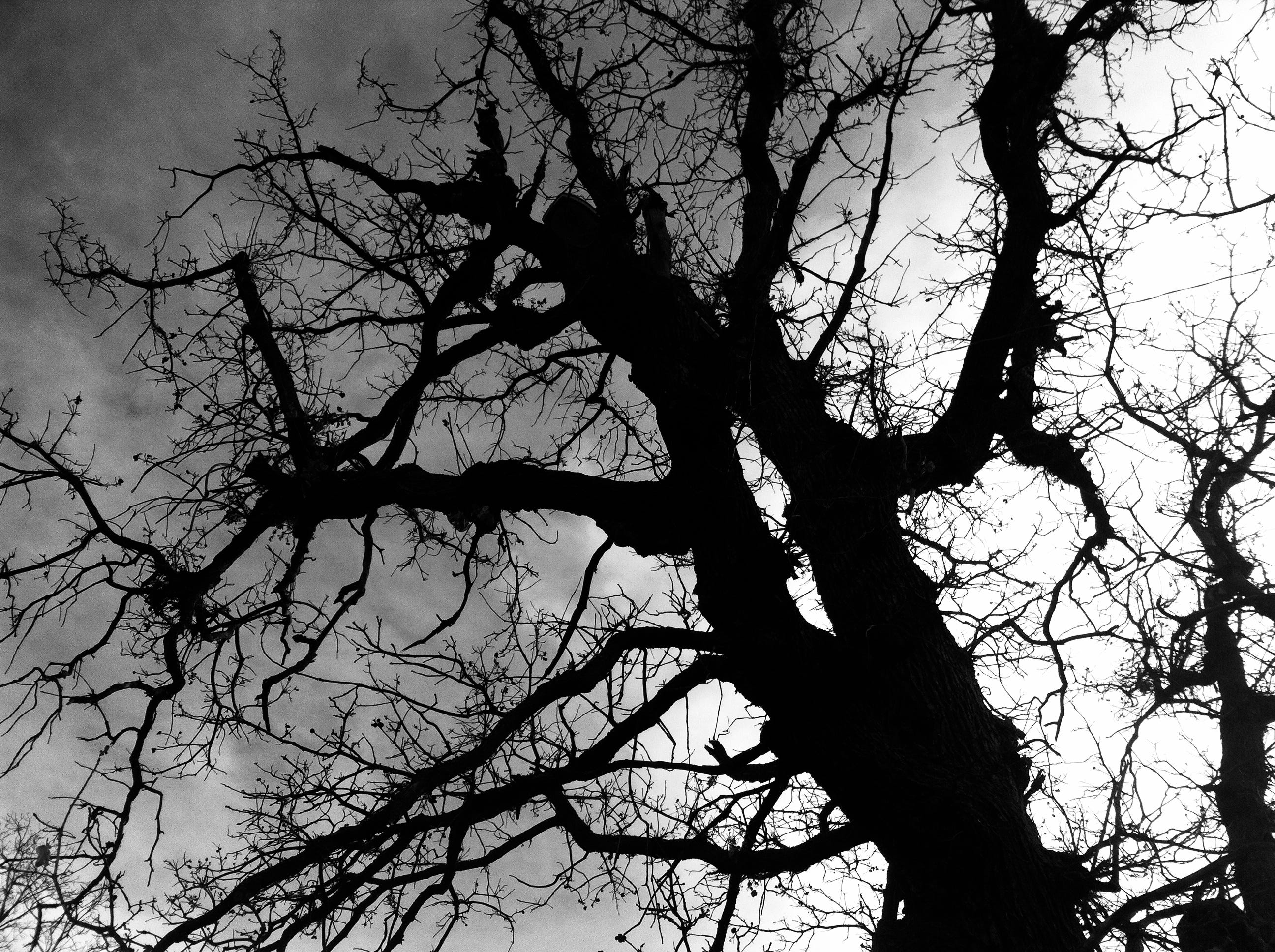

There’s an old Jewish folktale, from 12th century Germany, retold in the popular collection Lilith’s Cave, that goes something like this. A woodsman wanders into a part of the forest he’s never been to before. He finds a large tree that stands out among its surroundings and approaches it, but before he can begin to cut it down, he notices that it drips blood. Terrified, he drops his axe and high-tails it home. But the axe is how he makes a living. He consults a rabbi who says that he needs to get the axe back, despite the danger of approaching this demon-tree again. “For whatever object the demons obtain of a person, they hold the power of that object over him.” The woodsman returns to the tree and grabs his axe. But the axe is possessed, and “held him in its power” — “he felt it lifting, as if on its own, wrenching itself out of his hands. And at that very moment the axe cut him down.”
The moral: watch what you put down when you enter a realm with other laws, like the Yenne Velt or Otherworld or Fairyland. Wandering through the digital landscape, we must watch out for the swing of our own axe, the order of the Internet’s terrible grace.
More to come soon on digital sexuality, Pythagoras, etc.!