

misandristic antisemitism
no, Jewish men are not all nebbishes

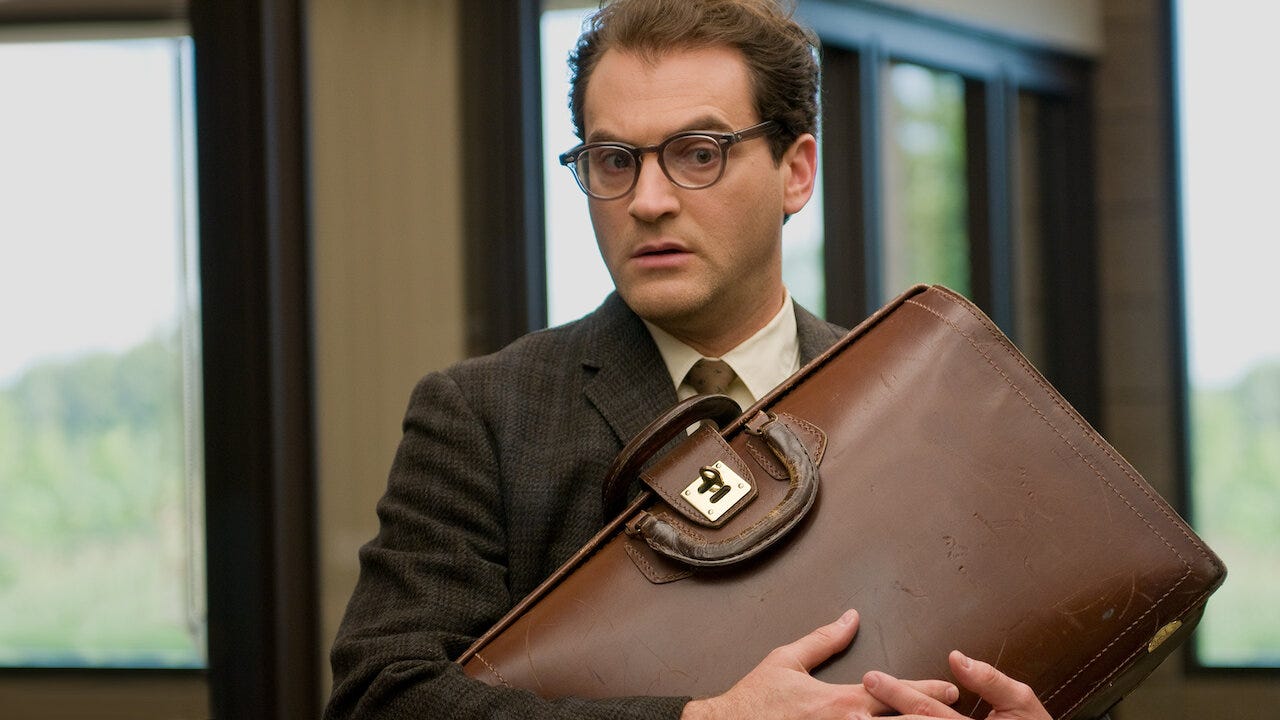
I’ve long noticed a trend in representations and stereotypes of Jewish men: that they’re vaguely snivelling, maybe learned, and domineered by the women in their lives. Take the 2009 film A Serious Man, for instance. The protagonist, Larry Gopnick, is at turns demeaned by his wife and seduced by a neighbour. He’s plowed over at work. He has no agency. Gopnick is a loser and a dweeb. He’s an academic but not that learned religiously; he’s a stereotypical liberal, non-urban-hub-dwelling Jew. Like Gopnick, the negatively-stereotypical Jewish man is weak, passive aggressive, stunted, muttering. A nebbish. I hate this! (For what it’s worth, Gopnick is actually pretty handsome.)
My dissertation is on misogynistic antisemitism, that cruel overlap between woman hating and Jew hating, particularly with regards to the fear of crypto-Jews — Jews who are outwardly non-Jewish but practice Judaism in secret. Women in particular come under fire when fears of crypto-Jewry explode; after all, even the Jewish tradition views them as God’s “secret agents,” as Devorah Fastag puts it. (Think Esther.) There’s a decent amount of research on this topic, too, on how Jewish women became more of a terrifying threat as Jews were racialised, yada-yada, I could go on about this. I do, for the length of a book, in fact. But I’ve more rarely seen pushback against misandristic antisemitism, as the offensive stereotype of the nerdy, hopeless Jewish man is widely propagated and — bizarrely — more or less celebrated. It’s great to celebrate Jewish intellectuality, but not the idea that half of all Jews are losers.
That perception simply doesn’t match up with my experience of Jewish masculinity. Sure, there are passive aggressive dorks in every crowd, and Jewish men are often well-educated. But also on average they’re cool dudes. They grill together, they’re strong leaders, they use their intellects for good, and they’re powerfully supportive of each other and of the women in their lives. They fixate on justice and work to achieve it. They see problems, intellectual and practical, and they work them out. Like all men, they do a little of everything. And, yes, a lot of them are hot, despite the bad PR campaign against them.
In fact, one old and annoying antisemitic trope is that Jewish men are ugly — and that on the flip side, Jewish women are abnormally hot, which is ultimately not to their benefit. In a 16th century antisemitic dialogue by the Christian Sebastian Münster, as translated in 1655 by the apostate Jew Eleazar bar Isajah, a Christian tells a rabbi:
For you Jewes have a peculiar colour of face, different from the form and figure of other men; which thing hath often fill’d me with admiration, for you are black and uncomely, and not white as other men.
To which the Jew:
It is a wonder, if wee be uncomely, why you Christians doe so love our women, and they seem to you more beautifull then your owne.
To which the Christian again:
Your women indeed are more comely than your men, but you seduce them most corruptly.
This idea of Jewish men as ugly has persisted, despite being obviously untrue. In the brilliant new podcast GOLDA Girls, I was glad to hear Rabbi Diana Fersko (at least if I’m following the voices right, it was her) push back against negative perceptions of Jewish men’s overall attractiveness:
I don’t like that Jewish men are often globbed in with male-focussed negativity in general, the whole idea that men are bad in one way or another. Of course, there are some bad Jewish men, but mostly what I see in Jewish families are menschy men who care so much about their partners, and their children, and are dedicated to the family and being a provider, and are smart, and I think those are all very attractive qualities for somebody you would want to be with. I feel defensive of Jewish men. They’re globbed into this anti-man energy.
Of course, anti-Jewish misandry is a little distinct from other forms of misandry. For instance, anti-black misandry tends to hold that black men are brutish and violent, I don’t need to run through all that, but with Jewish men, there’s a particular sense that they’re effete and whiny and so on, as I’ve sketched above. But they really aren’t. Sure, like R” Fersko sez, some Jewish men are bad, like any category of men. Some live down to the stereotypes. Most do not. And the fact that some are stereotypical is no excuse for the stereotype’s existence to begin with.
What does it communicate to Jewish boys when the tough guys are the antisemites and the Jewish man is emasculated and weak? For one thing, it communicates an inaccurate view of Jewish tradition and history. We have Samson, we have Judah Maccabee, we have all these great manly men in our tradition — and in our more recent history, too.
To be clear, I’m not saying that the only good Jewish men are stereotypically masculine. There are various ways to be a strong and good man — of course. I am pressing a little extra on the idea that Jewish men aren’t hot, which is blatantly false, ask any straight woman who isn’t an extreme antisemite and she can probably list several hot, male, Jewish celebs. My overall point here is pretty much that we need to set aside, and especially stop celebrating, anti-Jewish-male stereotypes and recognise Jewish men for who they are. Which is to say, on the whole, wonderful.
Lord Jacob Frank, perhaps the 18th century’s intensest male feminist, had a counterintuitive approach to this issue. Almost 300 years ago, he was already pushing back against the perception or self-perception that Jewish men are weak and unmanly. He identified that retreating from masculinity actually meant retreating from embodiment, thus departing from the feminine, too, which he associated with the body (in a positive way! he viewed rejecting the body in favour of a fictional spiritual reality as bad). Thus, being healthily masculine would actually also increase a healthy male femininity. Jay Michaelson, in The Heresy of Jacob Frank, writes of the Frankist masculine ethos: “The male hero acts as masculine sexual agent in order to be transformed into a feminine sexual agent, which is to say, an embodied one.” It’s a strange idea, but when men feel weak, they do seem to lash out more at women, and we need less of that right now by far. As men are or feel feminised they are more likely to hate the feminine.
Unlike Lord Jacob, I don’t want to tell Jewish men to change. They’re smart, kind, loyal, strong, charming, vital as they are. That’s my point here. I just want us to stop forcing a negatively feminised image of them.
I agree with most of what you say in this article but I think that Gopnik in "A serious man" is a more nuanced character than just being a simple loser. The issues that he deals with with his family and work are pretty common ones and the ways that he reacts to them are natural ways that many people would in the same situation
Seems eerily similar to the stereotype of weak, nerdy Asian man and feminine, desirable Asian girl.