

"desire cannot really be interrogated": feminism after separatism
feminist history and/in Phoebe Maltz Bovy's "The Last Straight Woman"

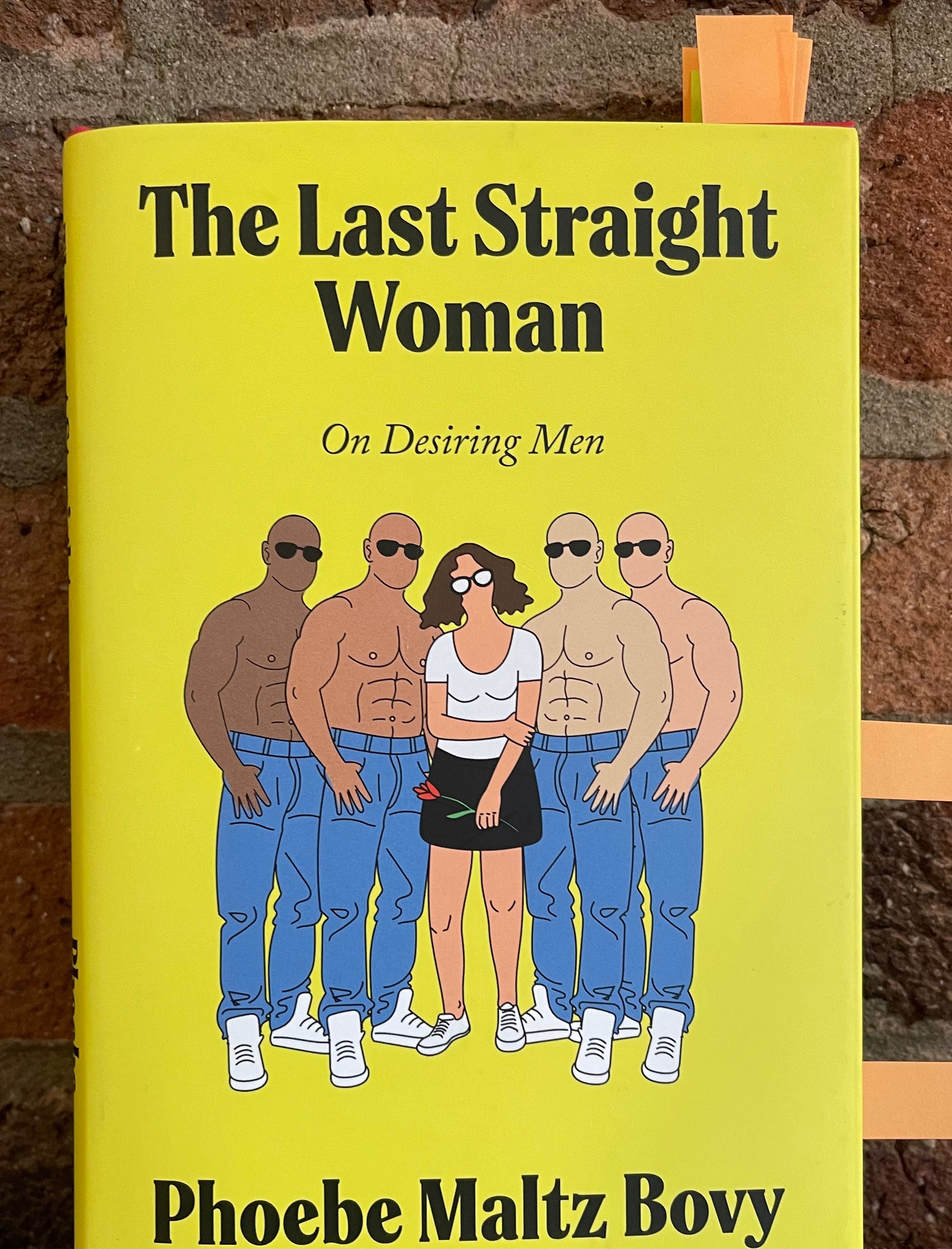
I’ve read Phoebe Maltz Bovy’s new book, The Last Straight Woman: On Desiring Men, it was a masterpiece, and I have a lot of thoughts.
A few of its central topics really grabbed me, and they’re mostly topics I knew would be there because I’ve followed Maltz Bovy’s writing/podcasting for a little while. The difference is that here she can get into much more depth, given it’s book-length rather than column-length, newsletter-length, podcast-length.
I would frame The Last Straight Woman’s central orientation as “post-separatist.” It deftly unpacks the ways that contemporary feminism has trended toward separatism and argues that, no, heterosexuality isn’t just a construct — most women are in fact often solely attracted to men.
Because the book’s central thrust relates to one of my areas of study, second-wave feminism, I wanted to follow up on the relevance of the book to feminist history. What follows is a little disjointed but I hope makes sense. Basically, I want to contextualise the position of The Last Straight Woman in radical feminist history (beyond how it discusses history, itself), and I want to address beauty discourse a wee bit in sources from the second and early third waves.
separatism
A kind of implicit feminist separatism is found in the first wave’s literature, if one goes a-lookin’. Take Charlotte Perkins Gilman’s Herland (1915), for instance, a novel about an all-women utopia, where women have learned to reproduce asexually. Or look at the thoroughly contemporary-feeling 1914 novel Angel Island by Inez Haynes Irwin, in which some lousy men are shipwrecked on an island inhabited only by female, angel-like beings — whose wings the men promptly hack off, forcing the angels into submission and ruining their all-female utopian lifestyles. Long before radical feminism, the implication had simmered in the feminist movement that an Adamless Eden is optimal.
Lesbian separatism, the repudiation of heterosexual relations, became a major ideological force in second-wave radical feminism. So ubiquitous was lesbian separatism in the movement that Carol Anne Douglas could write in 1990: “All radical and lesbian feminists favor some degree of separatism.”1
Lesbians had been marginalised during the first few years of the second wave, in large part thanks to Betty Friedan’s refusal to associate feminism with lesbianism. Nevertheless their women-centric lives and frequent lack of family responsibilities lent some of them more opportunity to engage in movement work. As Rosalyn Baxandall (on whom I have written more elsewhere) notes: “They had more time to spend, as men and children didn’t drain their energies. So, the movement began being known as gay.”2 To Friedan’s chagrin, lesbians wielded a tremendous influence in feminist work starting at the end of the 1960s, only a few years after the second wave had begun with Friedan’s The Feminine Mystique in 1963.
Among the first tremendous innovations of lesbian feminism was Radicalesbians’ creation of the framework of male- and woman-identification. A male-identified woman was a woman whose energy went primarily to men; a woman-identified woman, the ideal feminist, lent her energy to other women. We might now — as I’ve noted before — have seen somewhat of a revival of this line of thought in the dichotomy of pickme vs. girl’s girl. The theory of male- vs. woman-identified womanhood is foundational to lesbian feminist separatism.
Foundational, too, was early radical feminists’ experience with the non-feminist Left, where they had encountered sexism and a repression of women’s concerns. Robin Morgan writes, in a classic 1970 essay: “To hell with the simplistic notion that automatic freedom for women — or nonwhite peoples — will come about zap! with the advent of a socialist revolution. Bullshit.”3 Instead, wrote Morgan and many others, we need a movement led by women.
Radical feminists of the time were splitting from what they viewed as male-dominated cultures in other ways, too. They split from gay male organisers, and said — as Morgan puts it — “Goodbye to Hip Culture and the so-called Sexual Revolution, which has functioned toward women’s freedom as did the Reconstruction toward former slaves — reinstituting oppression by another name”4 Thus radical feminism split with men and male culture in many senses.
One of the pioneering works on the social construction of heterosexuality is Adrienne Rich’s 1980 paper “Compulsory Heterosexuality and Lesbian Existence.” In this paper she argues that, well, heterosexuality is compulsory — it’s something culture forces on women. Duh! However, she seems to leave open the option for a kind of non-oppressive heterosexuality. For still more radical feminists, this would not do. Just a year earlier, in a 1979 conference paper, Leeds Revolutionary Feminist Group write:
The heterosexual couple is the basic unit of the political structure of male supremacy… In the couple, love and sex are used to obscure the realities of oppression, to prevent women identifying with each other in order to revolt, and from identifying ‘their’ man as part of the enemy. Any woman who takes part in a heterosexual couple helps to shore up male supremacy by making its foundations stronger.5
And in her 1990 book Anticlimax, which I cite all the time, Leeds Revolutionary Feminist Group-affiliated lesbian feminist Sheila Jeffreys argues that all heterosexuality is a problem. She blasts:
But Rich’s paper did not encapsulate radical lesbian theorising on heterosexuality. One criticism of her paper is that by concentrating on a critique of “compulsory heterosexuality” rather than on heterosexuality per se, she has managed to validate “optional heterosexuality.” If it is only the compulsory nature of heterosexuality that is a problem, then feminists can say they have seen through all the pressures forcing them towards heterosexuality and have still, in the end, chosen it.6
Jeffreys undertook a lesbian separatist journey of her own. In her 2020 memoir, she describes how “completely reasonable arguments” by lesbian feminists led her to kick the men out of her house and life.7 Jeffreys’s time with her “first serious woman lover,” whom she had met via the Leeds Revolutionary Feminist Group, turned out to be revelatory.8 “The sexual part of our relationship, which was also intensely political since we were writing and doing activism together, was on a different plane from that which I had encountered with men. All my senses were engaged and there was no ending to our delights.”9 The issue here is that it seems like she had already been into women, to some subterranean extent. She isn’t a great exemplar for straight women going gay. Only a few pages before this, we read of how in an earlier relationship she “was interested in Danielle,” and how the “intimacy of the situation in the small room created some electricity between us and I was well aware that something delightful was going on.”10 That is not straight lady talk, I think. It would seem, based on her own writing, that Jeffreys was simply bi and undertook the thus relatively easy decision to give men the boot.
Lesbian separatism has not gone unchallenged over the years even among radical feminists. The Last Straight Woman, being as it is not radfem, launches a more totalising critique, but nevertheless it inherits a smol niche, more or less implicitly building off several past lines of criticism.
In a 1971 essay, Anne Koedt (on whom I’ve written more elsewhere) brought a few radical feminist challenges to bear again lesbian separatism. She argues that lesbian feminism is essentially individualist, promoting good feminist lifestyle choices without necessarily contributing to real action. Challenging the idea that “feminism is the theory, lesbianism is the practice,” Koedt writes, “not only is the sex of a woman’s lover insufficient information to infer radical feminism, but there is also the false implication that to have no men in your personal life means you are therefore living the life of fighting for radical feminist change.” Political lesbianism is an almost domestic decision, in other words. Koedt also challenges the root idea of woman-identified womanhood, arguing that instead, woman-identification should refer to identifying with one’s own role as woman (bringing it closer to how we use “gender identity” today), and: “So far as finding a term which describes women’s solidarity or sisterhood on the basis of our common oppression, the term is feminism.” This makes perfect sense. Why does feminism need another term? Koedt ultimately argues that the sex of one’s romantic or sexual partner shouldn’t be questioned. However, Koedt thus views universal bisexuality as the ideal. She can’t push far enough within her own framework.
Creeping closer to the practical approach we will find in Maltz Bovy, Carol Anne Douglas launches a pragmatic attack.
There is perhaps a tinge of unreality about some discussions of heterosexual relations. The structure of heterosexuality is oppressive, but relationships carried out within that structure vary… If we exaggerate too much, women with different experiences will not believe us, and we may wind up not believing ourselves. One of the first women to say that “every fuck is a rape” later got married.11
Lesbian separatism is detached from reality and its hardline nature, which fails to admit of exceptions (as Jeffreys overtly argues it should not), can end up crumbling as exceptions and galling lacks of commitment stack up. However broad its definition became — and as Josephine Donovan noted in the 1980s, “broad definitions of lesbianism have come to dominate” — still, lesbianism could not encompass all comers (or, uh, non-comers).12
We have entered, to some extent, a newly sex-negative era of feminism. Second-wave radical feminism asked what women could really consent to under patriarchy; #MeToo asked… kinda the same thing just less coherently. Maltz Bovy states what is basically its thesis tidily: “#MeToo-era feminism questioned whether women were on enough of a level playing field to consent to much of anything.”13 Accordingly, Maltz Bovy identifies in contemporary forms of feminism the recurrence of lesbian feminist separatist thought. “Contemporary understandings of gender are a particularly convenient fit for a revamped version of lesbian separatism.”14
Like many on the ol’ radical wing of feminism, contemporary feminists often view women’s heterosexuality as either a constructed imposition or not that important anyway. One of the core features of radical feminism is its interrogation of desire, which Ban Men feminism (as Maltz Bovy dubs it) also seems to uphold, whereas Maltz Bovy holds that “desire cannot really be interrogated.”15 Women do simply desire men.
In this way, Maltz Bovy advances past Koedt’s critique and furthers Douglas’s. Women, like men, are horny, even frumpy-but-horny, and we need to be realistic about this. After all, if “female heterosexuality remains by far the predominant experience among the population feminism occupies itself with, then we need to be looking for feminist approaches to female heterosexuality.”16 Maltz Bovy’s move is to look at women whose “tragedy is that their urges exceed their own desirability,” finding in this frumpy-but-horny cohort a host of exemplars of female heterosexual sincerity.17 Her thesis statement — or at least the passage that I think best summarises her argument — is:
The conversation we ought to be having is the one about all the ways women are nudged away from straightforwardly appreciating male beauty and towards obsessing over our own looks. Instead, one hears about how heterosexuality itself is a heteronormative imposition.18
I think, implicitly too, that Maltz Bovy picks up a Douglas-esque line of critique in poking at the ways that women try to opt out of straightness. Again, Douglas points out that failures in lesbian separatism’s totalising critique can highlight its flaws and lead women away from feminism. We may see this today in certain women’s half-baked attempts to quirk their way out of straightness. Ironically, certain key founders of lesbian separatism seemed to have introduced the conceptual framework precisely to make feminism seem more serious. How could you be a serious feminist and still fool around with men? Doesn’t that look hypocritical? Writes Alice Echols of Ti-Grace Atkinson, one of the founding mothers of radical feminism and of lesbian separatism:
…Atkinson appears to have been more concerned with the movement’s image than with the welfare of those feminists who continued to “consort with the enemy.” Atkinson desperately wanted the movement to be taken seriously, to be regarded as revolutionary… And in her view, radical feminists who continued to associated with men undermined the movement by making it appear ludicrous[.]19
I think this desire to be taken seriously is what drives a lot of the identification-out-of-straightness that Maltz Bovy (gently) critiques. But 2026 boasts more options than 1969, including identities that require no lifestyle adjustments to live out.20 Maltz Bovy does not offer much of a stance on the validity of various identities, nor would I, but certainly there is some way in which to be queer is better than to be square, in certain circles. (One always treads lightly on this topic.)
I want to look back at Maltz Bovy’s January 2025 review at the CJN of a then-new comedy special by Ilana Glazer, an article that to me reads like an extension of this identity-prodding aspect of The Last Straight Woman. Glazer had recently come out as using she/they pronouns, something her special apparently makes much of, because it means Glazer is “someone you’d least expect to be leading such a conventional life.” For “…Glazer is not like those other women who love their husbands and have babies with them and enjoy cleaning the house and help their inept-shopper husbands buy T-shirts.” Despite doing all these things, and discussing them, Glazer has identified out, escaping squarefulness. But Maltz Bovy is quick to note, aptly so, that one should be careful in “interpret[ing] this as a case of a functionally if not technically straight lady presenting herself as more interesting (or oppressed) than she is.”
Nevertheless, the questions of trendiness and fitting-in or flitting-out loom over the discussion of contemporary separatism. Is it possible that contemporary separatism is so domestic — as Koedt had critiqued its older form for being — that it is absorbed into image or even self-image? A matter of verbiage, “essentially a semantic difference of approach?” Who’s to say, really. This post is about The Last Straight Woman, primarily, but it’s worth clicking over to that CJN article too. Read both.
Maltz Bovy’s critique of separatism is essentially liberal, in the sense that it does not adopt the radical critique of desire. Nevertheless it occupies an interesting place in the lineage of these critiques. I think The Last Straight Woman has the potential to be the first significant literature in a totally post-separatist feminist movement.
The broad point I’d make about The Last Straight Woman in this regard is that it’s ensconced in the historical lineage of the second wave of feminist theory, not the third (I don’t buy that there’s been a fourth). I think this means something. The book relates contemporary feminism back to the second, which seems to me the most relevant. Judith Butler’s formerly core writing on heterosexuality is not relevant here or, it seems, very relevant to the broader culture. The second wave raised and hashed out the important questions and we’re returning to those tensions that remained in its wake but that weren’t so readily addressed by third-wave feminist theory. If a writer with a PhD in French finds ye olden Anglophone second-wave theory more relevant to the present discourse on sexuality than the third-wave poststructural sort, something is up. And we’re so back.
beauty and the frump
Well, I am a bitter joke. I am bitter and frustrated and wasted, but don’t you pretend for a minute as you look at me, forty-three, fat, and looking exactly my age, that I am not as alive as you are…21
In the crucial second-wave anthology Sisterhood is Powerful, one is sometimes surprised to read Zoe Moss’s piece on being viewed as old and still wanting men. She writes of older women, or rather of women who aren’t super young:
For her to have real living sexual desires is obscene. Her touch is thought to contaminate. No man “seduces” a woman older than him: there is no conquest. It is understood she would be “glad for a touch of it.” Since she would be glad, there can be no pleasure in the act.22
In sum, “an out-of-date woman is only embarrassing.”23 It’s embarrassing for a woman to be more lustful than lusted-after. To be frumpy-but-horny.
Maltz Bovy wants us to pay more attention to Moss’s archetype. “Zoe Moss” is a pseudonym, perhaps referencing how she’s still quite alive (zoe, from the Greek) but presumed or demanded to be asexual like moss, about which Maltz Bovy also jokes.24 Like Maltz Bovy, Moss is challenging the idea that only glamorous women are “sexual” beings at all. Except in the contemporary situation, it’s certain feminists who’re making the assumption that frumpy women aren’t sexual rather than (overt) misogynists.25 Ban Men feminism seems to assume that the average woman is Emily Ratajkowski, glamorous model, swamped in unwanted male attention. Admitting to liking or wanting male attention is taboo. “#MeToo, however, had little interest in the plight of the overlooked,” as Maltz Bovy points out.26 We don’t talk about frumpy-but-horny lust, “Lusting in ways that are awkward and strange, not arousing and titillating.”27 If we are going to accept that most women need and want men around, then the focus becomes how women look at, rather than only how they are looked at. Frumpy-but-horny is the ideal archetype for this mode of analysis.
Feminism used to care about beauty standards and how women are valued differently based on beauty — Moss engages in this discourse, arguing that “there is nothing natural about women’s obsolescence” — but the idea of calling out different degrees of beauty seems offensive today.28 Every woman is dragged down by constant catcalling, right..? No, not really. Just as incels deny the existence of femcels, feminism has come to adopt an incel perspective on women as essentially all always lusted-after, a tendency Maltz Bovy skewers.29
Perhaps one of the reasons that we’ve snapped out of being able to call out different applications of beauty standards is envy. I mean, in general, it’s awkward to call oneself plain or ugly because certain people always interpret it as fishing for compliments. But also the admission of envy can be embarrassing. Nancy Friday argues that “women are raised to deny beauty so as to ward off others’ envy,” and while I don’t take Friday’s angle of “warding off,” I think it’s fair to point out that it can also be awkward to discuss one’s beauty openly.30 Who doesn’t cringe a little when hearing radical feminist musician Emilie Autumn’s sarcastic song, “Thank God I’m Pretty,” for the first time? (I assume we’ve all listened to it and more than once.) It’s not polite to be envy-provoking by discussing one’s own great beauty and it would be humiliating to overrate one’s own looks. But Friday reminds us: “It is no good that older feminists today say beauty is not important; it is always important. It is the measure of beauty that changes.”31 Although Friday is displeased with “invisible” women’s complaints about their invisibility to men, I think she’s right to hold that we shouldn’t kid ourselves about the importance of beauty to feminist thought. We can point out that beauty standards change but we cannot pretend that beauty could ever go away. It’s possible that what happened with the “every woman is gorgeous and drowning in dick” trend is that women were afraid to call out different levels of beauty for fear of seeming envious or provocative of envy, or just of being cringe. It’s an inversion of Friday’s time, when “[b]eauty had to become politically incorrect[.]”32 Pointing out that not every woman is beautiful became un-PC.
All this is to say, I appreciated Maltz Bovy’s attention to the lustful and not lusted-after. Even though she differentiates frumpy-but-horny from femcels, what she seems to be referring to as femcels are post-femcels, as in women for whom being a so-called femcel is an aesthetic choice.33 Not being able to get laid and being a lil kooky about it is pure femcelness, is how I’d see it.
concluding reviewage
To be a bit more review-ish, in conclusion…
I’ve only scratched the surface of what Maltz Bovy addresses in The Last Straight Woman. Readers of Maltz Bovy’s other work will enjoy her analyses of sitcoms and of the sexual politics of refilling soap dispensers, her characteristic and entertaining syntactic quirks, and her broaching of the under-discussed topic of himbos. (I always think of Kirsch in Carmilla.) The sitcom aspect in particular was entertaining to me: as someone who has seen basically nothing she discusses except Frasier, I still appreciate when someone has a slice of media through which they can analyse the world. I have my Emilie Autumn and Kimberly Freeman CDs, Maltz Bovy has sitcoms, real recognises real. I mean, I’m not as real, but, you know. This was a very fun and smart book and you should buy it.
Carol Anne Douglas, Love & Politics: Radical Feminist & Lesbian Theories (1990), 250
Quoted in Clara Bingham, The Movement: How Women’s Liberation Transformed America, 1963-1973 (One Signal Publishers, 2024), 173
Robin Morgan, “Goodbye to All That,” in The Word of a Woman: Feminist Dispatches 1968-1992 (Norton, 1992), 64-65.
Morgan 61.
Leeds Revolutionary Feminist Group, “Political Lesbianism: The Case Against Heterosexuality,” in Love Your Enemy? The Debate between Heterosexual Feminism and Political Lesbianism (Onlywomen Pres, 1981), 10. Maltz Bovy discusses this book at length.
Sheila Jeffreys, Anticlimax: A Feminist Perspective on the Sexual Revolution (The Women’s Press Ltd., 1990), 295.
Sheila Jeffreys, Trigger Warning: My Lesbian Feminist Life (Spinifex, 2020), 71.
Jeffreys, Trigger 73.
Jeffreys, Trigger 74.
Jeffreys, Trigger 70.
Douglas 174-175.
Josephine Donovan, Feminist Theory: The Intellectual Traditions of American Feminism (Continuum, 1985), 163.
Maltz Bovy 28.
Maltz Bovy 102.
Maltz Bovy 13.
Maltz Bovy 8.
Maltz Bovy 240.
Maltz Bovy 229.
Alice Echols, Daring to be Bad: Radical Feminism in America 1967-1975 (University of Minnesota Press, 1989), 178.
Maltz Bovy 6.
Zoe Moss, “It Hurts to be Alive and Obsolete: The Ageing Woman,” in Sisterhood is Powerful: An Anthology of Writings from the Women’s Liberation Movement (Vintage, 1970), 175.
Moss 172.
Moss 170.
Moss 173. Unfortunately I can’t track down the page number for Maltz Bovy’s moss reference! Someone can correct me if my memory is faulty and she didn’t mention moss.
Maltz Bovy 228.
Maltz Bovy 29.
Maltz Bovy 243.
Moss 173.
Maltz Bovy 39.
Nancy Friday, The Power of Beauty (HarperCollins, 1996), 365.
Friday 515.
Friday 325.
Maltz Bovy 236.
I read this yesterday and enjoyed it and the pull quote just came up in my reading again; in an interview w/ Samantha Rose Hill on Arendt:
> Arendt talks about love in a few different ways. In The Human Condition, she talks about romantic love as the love that turns two people away from the world. It is anti-political because as the lovers are enveloped in one another, they become preoccupied with themselves.
In the piece that I HAVE to finish this weekend, I think about Arendt's treatment of private and political spheres semi-separate, and I think this little nugget rhyming with what the separatist has to say about how romance inures women to "my man" is a neat demonstration of the problem w/ collapsing these realms. It's not that what the critic is saying is wrong per se - obviously anyone who knows about abuse in relationships knows that people (not just, but often, women) do become blind to their partner's faults. It's that it's being made in the wrong place; in this context, it becomes (I think Arendt would say) 'totalitarian,' it's a criticism that one's own thoughts are interfering with the ideological program, literally an argument that the ideology can't withstand basic human empathy or connection.
Fan letter coming up. Thanks for another great piece! I really like the way you elucidate positions in how people relate to gender, point to questions that lie undiscussed because they would disturb the assuredness with which people speak of gender, and connect them to everyday dilemmas and emotional pains. All very valuable for someone like me, who works with men`s mental health and the male gender role, in an NGO who does men`s groups - broadening the way that ordinary men can relate to each other. We are always both criticizing how the traditional male role limits men´s lives and what men can be for others, while also defending men´s perspectives and the obligation of society to care for men. I look for voices that make it possible to think from the centre, and balance social constructivism with my own and other men´s lived experience of manhood and male sexuality. Your accounts of different perspective provide good support for this endeavor, as well as your tone - sharp, fun, coolheaded and basically trustworthy.